
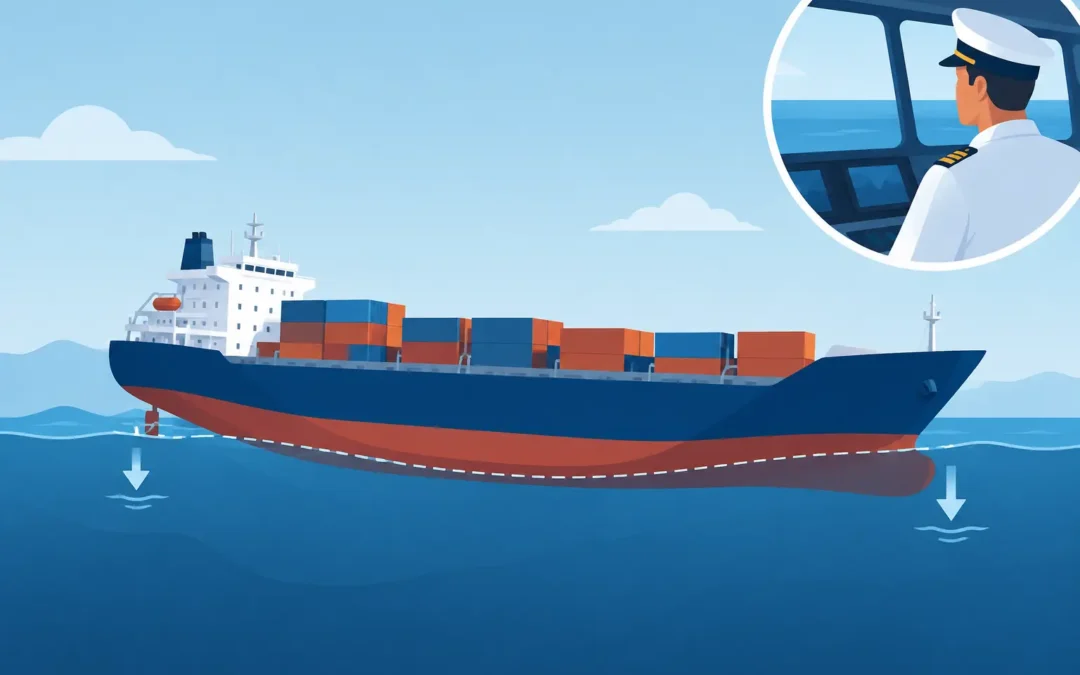
A vessel can have an apparently comfortable charted depth beneath it, then touch bottom in a channel that it has used safely before. The missing piece is often squat. Understanding why vessels squat is not just theory for an AMSA oral assessment. It is practical knowledge that affects passage planning, speed decisions, under-keel clearance and the safety of everyone aboard.
For Coxswains and Masters, the key point is simple: as a vessel makes way, it may sink deeper in the water and change trim. In restricted water, that movement can use up far more clearance than expected.
Why vessels squat in shallow water
Squat is the bodily sinkage and change of trim a vessel experiences when moving through water. As the hull travels ahead, water has to accelerate around and under it. That acceleration creates a reduction in pressure around the hull. The vessel settles lower until the pressure forces balance again.
In open, deep water the effect may be modest. In shallow water, a dredged channel, a river, or a confined harbour approach, there is less space for water to pass beneath and around the hull. The water must move faster, the pressure reduction becomes greater, and the vessel squats more.
Squat is commonly described as having two parts: sinkage, which is the overall increase in draught, and trim change, where either the bow or stern settles lower than the other. A full-form ship will often trim by the bow, while a fine-form, high-speed vessel may trim by the stern. That is a general guide only. Hull form, loading condition, propulsion arrangement and speed all influence what actually happens.
This is why a Master should never assume the deepest point remains at the stern. The vessel’s critical point during a shallow-water transit may move forward. If the bow is squatting, a sounder reading near the stern does not necessarily show the clearance under the bow.
Speed is the factor you can control
Speed has a major effect on squat. Increase speed and squat rises quickly, rather than in a straight line. As a practical rule, doubling speed can produce roughly four times the squat. That is why a small reduction in speed before entering a shallow reach can provide a useful safety margin.
A common training estimate is the Barrass formula:
- In open water, squat in metres may be estimated as block coefficient multiplied by speed squared, divided by 100.
- In confined water, the estimate may be approximately block coefficient multiplied by speed squared, divided by 50.
Speed is in knots. The block coefficient, often shown as Cb, describes the fullness of the hull. A fuller vessel has a higher coefficient and generally develops greater squat than a finer vessel at the same speed.
These formulas are planning aids, not a guarantee. Local port guidance, the vessel’s approved operating information, loading computer data and company procedures take priority. The actual result can differ because of channel shape, bank effects, tide, wave action, vessel trim and interaction with other traffic.
For an assessment, it is worth being able to explain the formula and its limitations. An assessor is usually looking for more than an answer from memory. They want to hear that you recognise squat is dynamic, that it increases with speed, and that a prudent Master includes a margin for uncertainty.
A practical example
Consider a vessel with a block coefficient of 0.70 travelling at 10 knots in confined water. Using the planning formula, the estimated squat is:
0.70 × 10² ÷ 50 = 1.4 metres.
If speed is reduced to 7 knots, the estimate becomes:
0.70 × 7² ÷ 50 = 0.69 metres.
That reduction of 3 knots has saved more than 0.7 metres of predicted clearance. On a marginal tide, that can be the difference between a controlled transit and a grounding.
The calculation alone is not the decision. You must then consider draught, trim, charted depth, height of tide, chart datum, likely tidal error, wave response, heel, density changes and the required under-keel clearance policy.
Confined channels make the problem worse
A vessel does not need to be in very shallow water for squat to matter. Narrow channels, canals, harbour entrances and berths can all increase the effect because the water flow is restricted by the bottom and banks.
Bank effect is closely related. When a vessel passes near a bank, water flow around the hull becomes uneven. The bow can be drawn towards the bank while the stern may be pushed away. Steering can feel less positive, particularly at speed. A Master trying to correct this with large helm movements may create a more difficult situation, especially where there is little room to recover.
Passing and overtaking can also affect a vessel’s movement. Pressure changes between two vessels may cause attraction or repulsion, with changes in heading and sinkage. The risk is greater in narrow water, at higher speeds and when large differences exist in vessel size or displacement.
These effects reinforce the same operational lesson: reduce speed early, keep the vessel within the planned channel, monitor position continuously and avoid treating charted depth as a fixed safety buffer.
Squat and under-keel clearance planning
Under-keel clearance, or UKC, is the vertical distance between the vessel’s deepest point and the seabed. It is not simply charted depth minus static draught. A sound plan accounts for the vessel’s dynamic movements and the uncertainty in every input.
A practical UKC calculation may need to allow for squat, heel during turns, roll and pitch in a seaway, wave height, tidal prediction error, survey accuracy, changes in draught from fuel or ballast use, and the possibility of a less favourable trim than planned. In some areas, the controlling depth may be an isolated shoal rather than the general channel depth.
For smaller commercial vessels, it is easy to underestimate this because the numbers look small. A 300 mm loss of clearance can be significant when crossing a bar, working in a tidal creek, approaching a ramp or carrying a load that has altered the vessel’s trim. For larger vessels, the consequences may be more severe, but the planning principle is identical.
Your echo sounder is a valuable cross-check, but it must be understood properly. Is it displaying depth below transducer, depth below keel, or depth below the surface? Has the correct offset been entered? Is the transducer located where the vessel is most likely to touch first? These are the sort of practical questions that turn a textbook answer into a competent operational answer.
How to manage squat before and during a transit
Good squat management begins before the vessel leaves the berth. Confirm the vessel’s actual draughts and trim, identify the limiting depth, check the height and timing of tide, and calculate a conservative speed for restricted areas. If available, review port or local operating guidance for speed limits, declared depths and required UKC.
During the transit, maintain a proper navigational watch. Compare position, charted contours, visual marks, tide information and sounder readings. If the vessel is not where it should be, if the tide appears lower than expected, or if handling feels unusual, slow down before the situation becomes critical.
It is also worth considering when to make the transit. Waiting for a more favourable stage of tide may be safer and more economical than trying to carry speed through a shallow channel. The trade-off is operational timing, weather windows and traffic movements, but schedule pressure is never a sound reason to gamble with clearance.
What assessors expect you to explain
In a Coxswain or Master assessment, squat questions often lead into wider judgement. You may be asked why a vessel trimmed by the bow in a dredged channel, what happens if speed increases, or how you would establish safe UKC for a particular passage.
A strong response explains the physical cause, identifies the factors that increase the risk, then describes the controls. Say that squat results from accelerated water flow and reduced pressure around the moving hull. Explain that it increases with speed and in shallow or confined water. Then show your operational response: calculate an allowance, reduce speed, plan on suitable tide, monitor depth and position, and comply with local requirements.
That structure demonstrates that you can apply the knowledge under pressure, not merely repeat a definition. It is the same approach used in one-on-one revision at True North Marine Training: connect the calculation to the decision a Master must make on the water.
The most useful habit is to treat depth as a changing operational condition, not a number printed on a chart. When clearance is limited, slow down early, question your assumptions and leave yourself room to make the safe decision.