
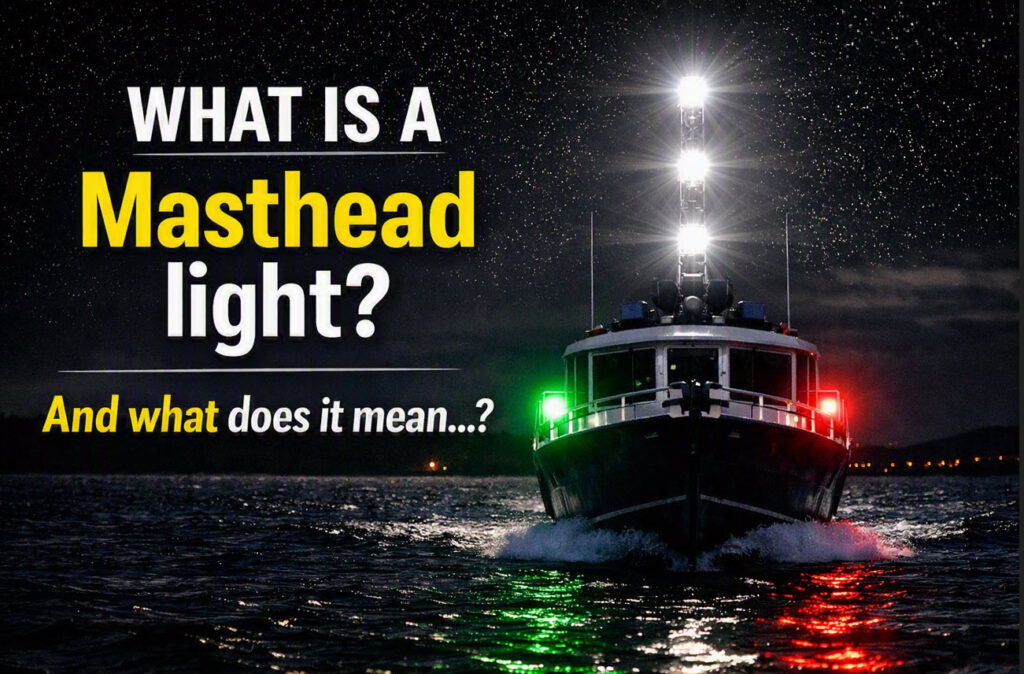
In today’s video I want to talk about what is a masthead light and what does it mean?
When I ask candidates to explain a masthead light the most common response is that it is a white light at the top of the mast.
I understand that the name of the light implies this. But this response is incorrect. Lets take a look at the rule for towing for a moment. When a vessel is engaged in towing it displays 2 or 3 masthead lights, depending on the length of tow, in a vertical line one above the other on the same mast. Clearly from this example you can see that it’s not possible for all the lights to be at the top of the mast.
So if you are going to learn one thing from this video today it should be the correct definition of a masthead light. The definition then of a masthead light is simply a white light shining over an arc of 225 degrees from dead ahead to 22.5 degrees abaft the beam on each side. That’s it. That’s the definition.
Yes the light will be on a mast but not at the masthead as the name implies.
Now we have to know which vessels display a masthead light. Again this is very simple and straightforward. The answer is a power-driven vessel. That’s it again.
So a vessel is power-driven vessel by night it will show a masthead light. By day it’s easy to determine that a vessel is power-driven but at night it’s not, so when we see the light displayed that tells us the vessel is power-driven. That’s it.
So why is this important. Well the rules tell us what to do when 2 power-driven vessels are crossing each other’s path or meeting head on in order to avoid a collision. So one of the first things we need to do at night is to determine if the vessel we have in sight is power-driven or not.
The ability to identify the white masthead light on another vessel, or the absence of it, answers that question.
If the masthead light is not displayed, for example a yacht under sail or a vessel being towed, then as a power-driven vessel we must keep clear of the other vessel because they are not power-driven.
It’s important to understand that just because a vessel is a sailing vessel by design if they are using engines they become a power-driven vessel, must display the masthead light and must follow the stand on, give way crossing rules or the head on meeting rules like the rest of us. They only gain priority when under sail only. So there you have it. The importance of understanding and identifying a masthead light.
If you are studying for an AMSA marine qualification such as a Coxswain Grade 1 NC, Coxswain Grade 2 NC, Coxswain Grade 3 NC, Master less than 24 metres or Master less than 45 metres and need assistance in preparing for an assessment email us at maritimetutor@yahoo.com or visit our website at https://www.truenorthmarine.com.au for information on how we can help you.