
CLICK ON THE IMAGE BELOW TO WATCH THE YOUTUBE VIDEO
In today’s True North Marine’s training video, we’re answering the question – What does Restricted in their Ability to Manoeuvre mean..?
A vessel is restricted in Ability to Manoeuvre, or RAM, when the nature of the work it’s doing makes it unable to manoeuvre the way the rules normally require. Unlike NUC, where something breaks unexpectedly, RAM is about planned work that limits the vessel’s ability to keep clear of others. Think of it like this, if a vessel is doing a job so specialised that it simply can’t move out of the way of other vessels, such dredging, laying a pipeline, transferring cargo or people, or towing something large then it will display the RAM signals.
RAM means ‘I’m working, and I can’t manoeuvre safely — please keep clear.’
What signals does a RAM vessel show?
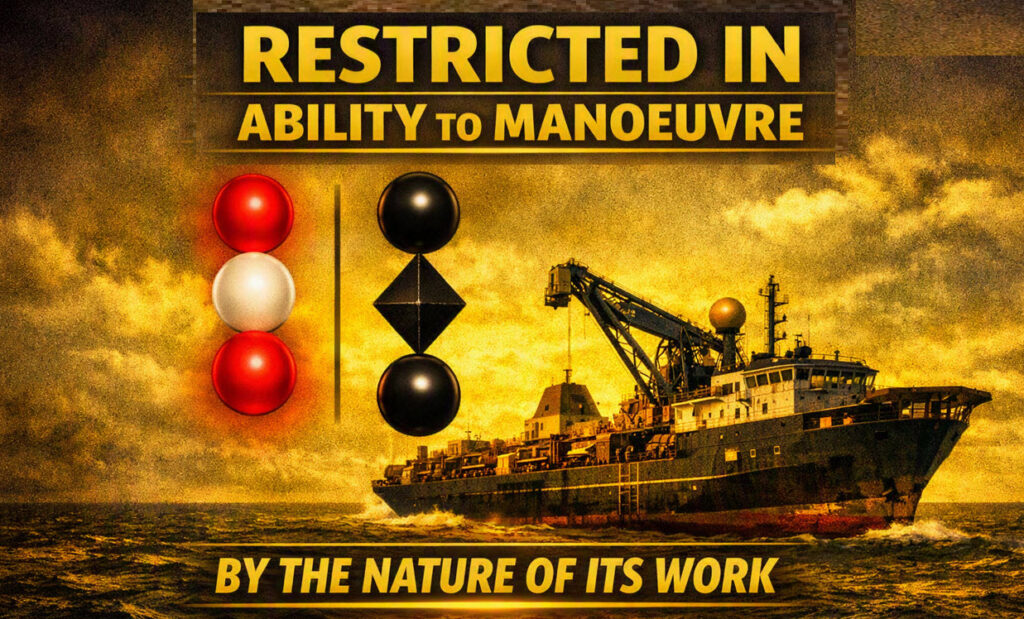
By night Three all‑round lights in a vertical line: Red over White over Red If the vessel is making way, it also shows masthead lights, sidelights and a stern light.
By day the signal is Three shapes in a vertical line where than can best be seen: A Ball Diamond Ball.
Remember under international rules all day shapes are black.
If it’s at anchor, it shows the anchor lights at night or the shape by day as well. The RAM signal means the vessel is restricted by work that limits its ability to manoeuvre.
Here are everyday examples of vessels that are genuinely restricted because of the work they’re doing.
1. Servicing Navigation marks or buoys, or cable laying
2. Working on submarine cables or pipelines These vessels often have gear over the side and cannot move freely.
3. Replenishment or transfer operations while making way This maybe ships transferring cargo or personnel at sea where two vessels maybe connected together and cannot manoeuvre quickly
4. Launching or recovering aircraft During Flight‑deck operations the ship must maintain a steady course and cannot turn suddenly.
5. Dredging, surveying, or underwater operations Vessels dredging or conducting Underwater operations may also show extra lights or shapes to mark an obstruction and which side is safe to pass.
6. Towing operations that severely restricts the movement of the towing vessel due to heavy or awkward tows – If the tow is so large or difficult that the tug cannot deviate from its course, it will show RAM signals.
These are all situations where the work itself restricts the vessel — not a breakdown, not bad weather, but the job being performed.
7. Dredging and underwater operations require a special mention Dredgers and underwater‑operations vessels often need to show extra signals due to there often being an obstruction on one side of the vessel
Two red lights or two balls mark the obstruction side — the side other vessels must avoid.
Two green lights or two diamonds mark the safe side — the side other vessels may pass.
This tells approaching vessels exactly where the danger or obstruction is.
Smaller vessels are still required display the same RAM Red‑white‑red lights at night, especially during diving operations, and they will also show the Two red lights or two balls by day to show the obstruction side or diving side — the side other vessels must avoid. And Two green lights or two diamonds by day to show the safe side — the side other vessels should pass.
By day a vessel conducting diving operations will also show a rigid Code Flag ‘A’ at least one metre high, visible all around. The ‘A’ flag means: ‘Diver down — keep well clear and proceed at slow speed.’”