
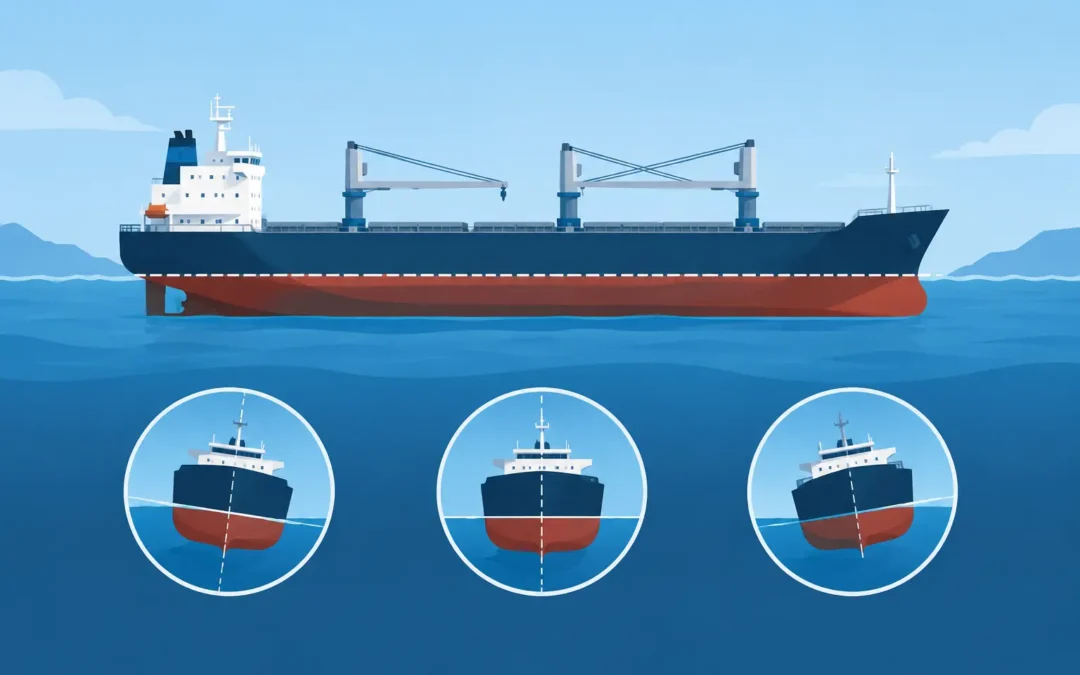
A vessel sitting noticeably down by the stern may still feel perfectly normal at the berth. Once it is making way, however, that same trim can affect visibility, steering response, propeller immersion, resistance and the way the boat handles a following sea. Vessel trim principles are therefore not just a stability theory question. They are part of the everyday judgement expected of a Coxswain or Master.
For AMSA assessment candidates, trim is often tested through practical questioning. An assessor may not simply ask for a definition. They may give you a loading situation, a fuel transfer plan or a poor-handling report and ask what is happening, what risks it creates and what action you would take. A sound answer connects the numbers and terminology to safe vessel operation.
What vessel trim actually means
Trim is the difference between a vessel’s draught forward and draught aft. A vessel is trimmed by the stern when its aft draught is greater than its forward draught. It is trimmed by the head when the forward draught is greater. When draughts are equal, it is on an even keel.
Do not confuse trim with list. Trim is a fore-and-aft condition; list is a permanent heel to port or starboard, generally caused by an off-centre weight or an uneven distribution of buoyancy. A vessel can have both a list and a trim at the same time, which is why accurate draught readings matter.
The point about trim is not that an even keel is always correct. Many vessels have a designed operating trim. A planing recreational vessel may need a different attitude from a loaded displacement workboat, while a tug, fishing vessel or passenger vessel may have particular draught, propeller and visibility requirements. The safe condition is the one that stays within the vessel’s approved limits and allows it to perform properly for the voyage.
The vessel trim principles behind the calculation
Trim changes when weight is moved longitudinally – forwards or aft. Loading stores in the forepeak, transferring fuel from an aft tank to a forward tank, landing a heavy item on the bow or shifting deck cargo aft can all change the vessel’s trim.
The direction is straightforward. Moving weight aft trims the vessel by the stern. Moving weight forward trims it by the head. The amount of trim depends on three things: the weight moved, the distance it moves and the vessel’s moment to change trim by one centimetre, commonly called MCTC.
In basic form:
Trimming moment = weight moved × distance moved
Change of trim in centimetres = trimming moment ÷ MCTC
If 10 tonnes is transferred 20 metres aft, the trimming moment is 200 tonne-metres. If the vessel’s MCTC is 10 tonne-metres per centimetre, the total change of trim is 20 cm by the stern. In an assessment, show the method clearly, state the units and describe what the result means operationally.
A common trap is assuming that the calculated change is split equally between the forward and aft draught marks. Whether it is split evenly depends on the position of the longitudinal centre of flotation, or LCF. The vessel effectively pivots about the LCF as it trims. If the LCF is not amidships, the change at each end will not be equal.
Trim versus sinkage
Adding weight causes mean draught to increase because the vessel sinks further into the water. This is separate from trim. If weight is added exactly at the LCF, it may produce sinkage with little or no change of trim. If weight is moved within the vessel, displacement stays the same, but the vessel’s trim changes.
Candidates who separate these two effects demonstrate that they understand the vessel rather than simply applying a formula. In practice, both may occur at once when taking on fuel, stores, cargo or equipment.
Why excessive trim creates operational problems
A moderate trim may be normal. Excessive or unsuitable trim can quickly become a safety and performance issue, particularly on smaller commercial vessels where loading changes through the day.
Trim by the stern may reduce forward visibility from the wheelhouse, especially during acceleration or in a seaway. It can make a vessel slower to respond to the helm, increase resistance and, depending on hull form, alter directional stability. It may improve propeller immersion in some conditions, but a deep stern can also bring the rudder, transom or stern gear closer to a limiting draught or shallow-water risk.
Trim by the head can drive the bow deeper into oncoming seas. The vessel may ship more water, pound heavily, lose speed and put greater load on people, fittings and cargo lashings. On some vessels it can reduce propeller immersion at the stern, leading to ventilation, racing and reduced manoeuvrability.
Neither condition can be judged in isolation. Consider the weather, intended speed, water depth, vessel design, load line restrictions, downflooding points and the type of work being undertaken. A trim that is acceptable for a short sheltered transit may be inappropriate for an offshore passage or a bar crossing.
Loading decisions that protect the vessel
Good trim management starts before departure. Read the vessel’s stability information, loading guidance and operating limitations for the actual vessel. These documents take priority over rules of thumb, because hull form, tank layout and approved conditions differ greatly.
When planning a load, distribute heavy items as low as practicable and avoid concentrating too much weight at either end. Keep an eye on longitudinal as well as transverse distribution. A heavy piece of machinery, a load of ice, deck cargo or even a full bait bin may have a meaningful effect on a small vessel’s trim.
Tank management deserves particular care. Transferring fuel can correct trim, but it may also create or worsen free-surface effect if tanks are left slack. Free surface reduces stability by allowing liquid to move as the vessel heels. It is a transverse stability issue rather than a direct trimming effect, yet it must be considered whenever you are using liquids to manage a longitudinal problem.
Before sailing, confirm draughts where practical, check visibility from the normal conning position and make sure freeing ports, scuppers and drainage arrangements are not compromised. If the vessel has a stated maximum draught, compare the actual draught at the relevant point with that limitation, not just an average figure.
Correcting a poor trim underway
If a vessel develops an unsuitable trim, reduce risk before trying to fix the appearance of the boat. Slow down if slamming, poor visibility or steering response is becoming an issue. Alter course where safe to lessen impact from the sea. Secure loose gear and reassess the load condition.
Only transfer liquids or move weight in accordance with the vessel’s procedures and after considering stability, structural limits and the consequences of having personnel shift heavy items. On many vessels, a rushed fuel transfer is not the answer. The safer decision may be to reduce speed, seek shelter or return to a suitable berth for a controlled adjustment.
How to answer trim questions in an AMSA assessment
Start with a plain definition, then apply it to the scenario. For example: “The vessel is trimmed by the stern because the aft draught is greater than the forward draught. This may affect visibility and steering, and I would check the vessel’s loading information before considering a controlled transfer of weight or fuel.” That answer shows definition, consequence and action.
For calculations, talk the assessor through your working. Identify the weight, distance moved, direction of movement and MCTC. State whether the result is trim by the head or stern. If asked to calculate final draughts, explain the role of LCF and distinguish trim from sinkage.
It also helps to be honest about vessel-specific information. Rather than guessing a limit, say that you would refer to the approved stability booklet, loading manual or operational procedures. A Master is expected to know where critical information is held and to use it properly.
At True North Marine Training, one-on-one revision can turn this topic from a set of unfamiliar hydrostatic terms into the practical decisions you may need to explain under direct questioning. The goal is not to memorise a polished answer. It is to be able to look at a vessel condition, recognise the risks and explain your next safe step with confidence.
The best preparation is to practise with real loading scenarios until the relationship between weight, distance, draught and vessel behaviour becomes clear. When an assessor asks what you would do, your answer should sound like the decision of someone ready to take responsibility on the water.