
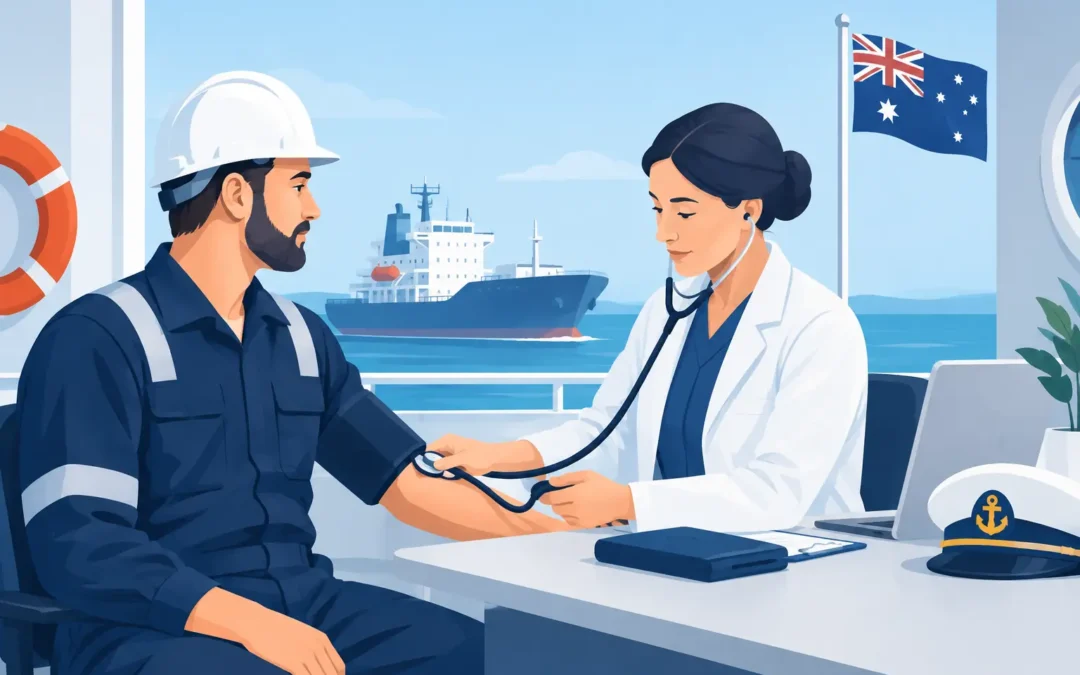
A medical issue that seems minor on shore can become a serious operational risk once you are responsible for a vessel, passengers, crew or a casualty at sea. That is why seafarer medical requirements are not simply paperwork to tick off before a course or assessment. They are designed to confirm that you can safely carry out the duties attached to your role, including when conditions are tiring, noisy, remote and time-critical.
For Australian candidates working towards Coxswain or Master qualifications, the medical requirement can be confusing because it depends on the certificate, the vessel operation and the work you will actually perform. Some candidates need a formal AMSA Certificate of Medical Fitness. Others may need to meet a different fitness standard, provide a declaration, or satisfy an employer’s medical process. Getting clear on this early prevents a last-minute delay after you have completed training, gained sea service and booked an assessment.
Why medical fitness matters at sea
A commercial vessel is not a controlled office environment. You may be climbing ladders in poor weather, handling lines, maintaining a lookout for long periods, working around machinery, responding to a fire alarm or making decisions after a broken sleep. On a smaller vessel, there may be no spare person to take over a safety-critical duty.
Medical fitness assesses whether a condition, medication or limitation could affect your ability to work safely in that setting. It is not about excluding people unnecessarily. A competent medical practitioner considers the individual, the role and the operating environment. Many people with managed medical conditions work successfully in maritime roles, but they may need further information, treatment stability or reasonable restrictions.
The key question is practical: can you reliably perform the duties of your intended job without creating an unacceptable risk to yourself, the crew, passengers or the vessel?
When seafarer medical requirements apply
For work on regulated Australian vessels and for particular certificates of competency, AMSA may require a Certificate of Medical Fitness. The required standard can differ depending on whether you are serving as master, deck crew, engineer or in another capacity, and on the type of operation involved.
Candidates should not assume that completing a Coxswain or Master course automatically settles the medical side. Your training provider, assessor or employer may identify a medical requirement, but it remains your responsibility to confirm what applies to your certificate and planned employment. Requirements can also change, so rely on current AMSA guidance and the advice of an approved medical practitioner rather than an old form passed around the wharf.
A formal medical is commonly more relevant where duties involve watchkeeping, command responsibilities, remote operations or work where sudden incapacity could have immediate consequences. Employers may also require pre-employment, drug and alcohol, fatigue or task-specific medical assessments beyond the minimum certification requirement.
That distinction matters. Passing an AMSA medical does not necessarily mean you have met every employer requirement, and meeting an employer’s standard does not automatically replace a required AMSA certificate.
Your intended duties affect the outcome
Be accurate when describing the work you expect to do. A master on a passenger vessel, a deckhand on a fishing boat, a marine rescue volunteer and a person working aboard a harbour tug may all face different physical and operational demands.
Tell the practitioner if your role involves night work, irregular rosters, lone watchkeeping, heavy manual handling, working at height, confined spaces, tender transfers or operating in remote areas. These details give context to conditions that may be manageable in one job but require closer consideration in another.
What the medical assessment usually considers
A maritime medical assessment generally looks beyond whether you feel fit on a good day. The practitioner needs to consider whether your health is stable and whether you can safely perform emergency and routine duties over the period of certification.
Vision is a major area. Safe navigation depends on reading charts and instruments, identifying lights and marks, recognising hazards, judging distance and maintaining an effective lookout. Depending on the role, the assessment may consider distance vision, near vision, colour perception and whether corrective lenses are required. If you wear glasses or contact lenses, take them to the appointment and keep an up-to-date spare pair available for work.
Hearing matters for communications, alarms, machinery changes and verbal instructions on deck. The practitioner may consider whether hearing aids are used and whether they provide reliable function in a maritime environment. Do not leave this until the day of the medical if you have noticed a gradual change in hearing.
Other areas may include cardiovascular health, respiratory conditions, diabetes, neurological conditions, mental health, sleep disorders, mobility, balance and medication use. A history of blackouts, seizures, serious heart symptoms, severe anxiety, problematic substance use or a condition that can suddenly impair awareness needs to be discussed openly. Trying to conceal it can create a far larger problem later, particularly after an incident.
Mental health should be approached with the same common sense as physical health. A past diagnosis does not automatically mean you cannot work at sea. What matters is the nature of the condition, treatment, stability, side effects and the demands of the role. Honest information allows the practitioner to make a fair assessment and, where appropriate, seek specialist advice.
How to prepare for your appointment
A little preparation makes the medical process more straightforward. Book with a practitioner authorised to complete the specific assessment you require, rather than assuming any general medical appointment will be suitable. Confirm the correct form and bring suitable identification.
Take details of your medical history, current medications and treating specialists. If you have recently had investigations, surgery or a change in treatment, bring relevant reports or letters. This is particularly useful for conditions such as sleep apnoea, diabetes, cardiac issues, asthma, depression or anxiety, where evidence of stable management may help the practitioner understand your fitness.
It also pays to arrive with a clear explanation of your intended work. Saying you are getting a maritime ticket is less useful than explaining that you intend to work as a Coxswain on a tourist vessel, undertake deck duties on a fishing vessel, or progress into command on a workboat. The role gives the medical assessment its proper operational context.
Avoid treating the appointment as a test to bluff your way through. The best result is an accurate one. If you are issued with a condition or restriction, understand exactly what it means before you accept a job or plan a qualification pathway around it.
Common issues that catch candidates out
The most common problem is timing. A candidate may complete training, build sea service over several years and then discover that their medical evidence is expired, incomplete or does not match the certificate they are applying for. Medical certificates have validity periods, and the period may be shorter where a condition needs review.
Another issue is assuming a prescription is irrelevant because it has been taken for years. Some medications can affect alertness, reaction time, balance or judgement. The relevant question is not whether the medication is lawful or familiar. It is whether it affects safe performance of maritime duties, especially during a long shift or an emergency.
Vision can also surprise candidates who manage well in everyday life but have not had an eye test for years. Reading a mobile screen and driving to the shops are not the same as identifying a navigation light, checking a radar display or reading a chart under reduced lighting.
Finally, do not confuse medical fitness with practical competency. A medical certificate does not prepare you to explain collision regulations, conduct stability calculations, manage an emergency or answer an AMSA assessor’s follow-up questions. It is one part of being ready for the responsibility that comes with a certificate of competency.
Medical fitness and your AMSA assessment pathway
If you are returning to study after a long period gaining sea time, it is sensible to check the medical component alongside your evidence of sea service, course completion and assessment preparation. That way, you are not revising radar plotting, tides, stability and emergency procedures only to be held up by an administrative or medical issue.
For candidates preparing for an oral assessment, medical fitness also connects directly to the scenarios you may be asked about. An assessor wants to see that you understand responsibility, risk controls and the limits of your role. A good answer to an emergency scenario includes calling for help, using available crew, managing fatigue and making sound decisions, not pretending that a master can do everything alone.
True North Marine Training helps candidates focus their revision on the actual knowledge areas they need to demonstrate, particularly where time away from formal study has knocked confidence. Your medical paperwork is separate from tutoring, but getting both streams organised early makes the final run towards assessment far less stressful.
If you are unsure which medical standard applies, ask the question before you commit to a job, course date or assessment booking. A clear answer now gives you time to address any issue properly and step aboard confident that you are ready for the work, not merely the paperwork.