
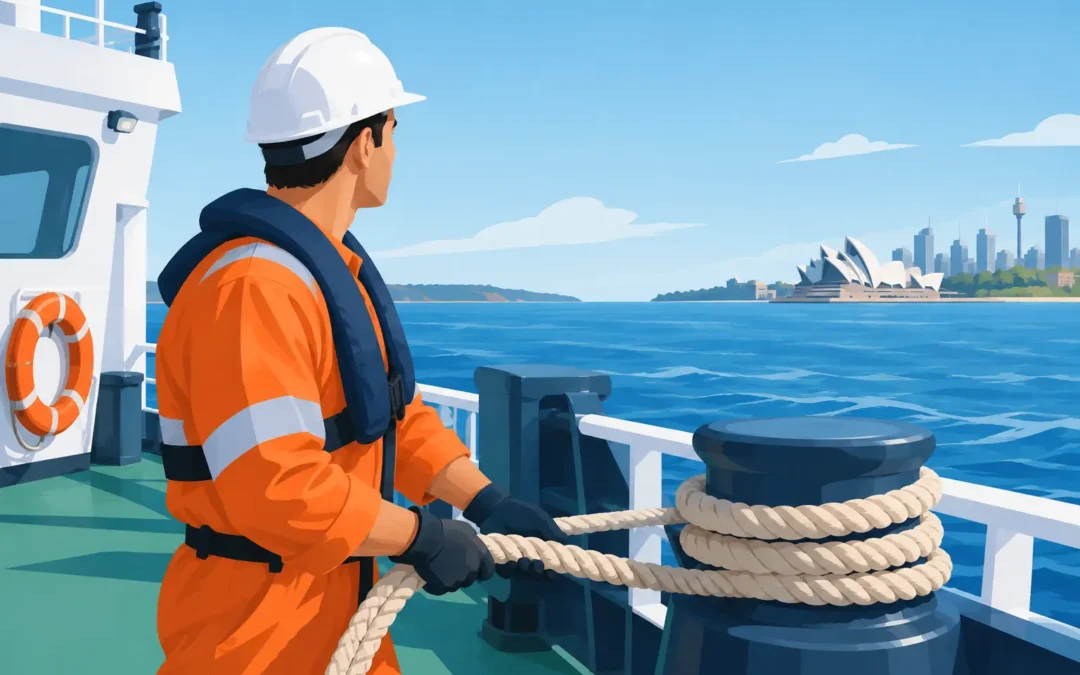
A deckhand career guide should start with the part people often learn on their first hard day at sea: being useful on deck is about far more than handling a rope. A good deckhand works safely, anticipates what the skipper and crew need, understands the vessel’s routines, and stays calm when weather, machinery or a passenger situation changes the plan. It can be an excellent entry point into commercial maritime work, but it rewards preparation and a professional attitude.
For many Australians, deckhand work is the first proper step towards Coxswain or Master qualifications. The sea service, vessel familiarity and operational judgement gained along the way can become the foundation for a long career in fishing, tourism, ferries, workboats, tugs, offshore support, marine rescue or remote-area operations.
What a deckhand actually does
The exact role depends on the vessel and operation. A deckhand on a busy tourism vessel may spend much of the day assisting passengers, cleaning, preparing gear and supporting safe embarkation. On a fishing vessel, the work may centre on deck machinery, catch handling, gear maintenance and watchkeeping duties. On a tug, barge, ferry or workboat, the job can involve mooring operations, towing preparation, cargo-related tasks and close coordination with the Master.
Across these jobs, the common thread is safe deck work. That includes correct use of personal protective equipment, line handling, keeping decks clear, checking equipment, communicating clearly and following the vessel’s safety management procedures. You may also assist with lookout duties, routine maintenance, basic navigation tasks, emergency drills, refuelling procedures and passenger safety.
The work can be physically demanding and repetitive. It may involve early starts, shift work, heat, rain, rough water and time away from home. At the same time, it offers something many shore-based jobs cannot: practical responsibility in a close-knit team where your reliability is noticed quickly.
Qualifications for a deckhand career in Australia
There is no single qualification that applies to every deckhand job. The requirements depend on the vessel’s survey status, its operational area, the work being performed, employer policy and whether the operation falls under domestic commercial vessel or international requirements.
Some entry-level positions may focus on induction, vessel-specific training, safety procedures and demonstrated competence under supervision. Other roles require recognised certificates of competency or specific safety training before you can be employed. Jobs on larger vessels, offshore operations or vessels operating under international conventions can have different certification expectations again.
Before committing to a course, read actual job advertisements in the area of maritime work you want to enter. Look for repeated requirements such as first aid, marine radio knowledge, security awareness, survival training, a medical certificate, a recreational boat licence, Coxswain certification or previous sea service. Employers often value the right tickets, but they also want someone who understands that paperwork alone does not make a safe crew member.
If your goal is to progress beyond deckhand duties, a Coxswain qualification can be a logical next move. It can support work on smaller commercial vessels within the limits of the certificate. Later, eligible candidates may work towards a Master less than 24 metres qualification or another pathway suited to their operation. Each step has formal requirements, including approved training, sea service and assessment components, so check the current AMSA requirements before making decisions.
Sea service is more than time on a boat
A common mistake is to treat sea service as a number to collect. For career progression, the quality of your experience matters as well. Time spent actively involved in vessel operations gives you material to draw on when an assessor asks how you would prepare for heavy weather, respond to a fire, manage a person overboard or calculate a passage.
Keep accurate records from your first day. Record vessel details, dates, hours or days, the nature of the voyage, your duties and the Master’s verification where required. Keep copies of supporting documents rather than relying on memory months or years later. A well-kept sea service record reduces stress when it is time to apply for a certificate.
How to become the deckhand a skipper wants to rehire
Technical skills can be taught, but your day-to-day conduct determines your reputation. Turn up early enough to be ready for the job, not walking onto the vessel at start time. Listen carefully during pre-departure discussions, ask sensible questions when unsure, and repeat back critical instructions if conditions are noisy or the task has consequences.
Line handling is a good example. It is not simply pulling in a rope. You need to understand snap-back zones, pinch points, bights, leads, cleats, bollards and the effect of wind, tide and vessel movement. Never step into a bight or assume a line is unloaded because it looks harmless. Deckhands who respect stored energy and communicate during mooring operations help prevent serious injuries.
Maintenance matters too. Washing down, cleaning bilges, checking deck fittings, greasing equipment and reporting corrosion may not sound exciting, but these tasks keep a vessel operational. A deckhand who spots a frayed line, damaged shackle or loose guard before it becomes a failure is adding real value.
Good situational awareness also sets people apart. Know where lifesaving appliances are stored. Notice changes in weather and visibility. Keep an effective lookout when asked. Learn the vessel’s alarm signals and emergency stations. If you are unsure whether something is safe, stop and ask. Speaking up early is professional seamanship, not a weakness.
Build skills that support career progression
The strongest deckhands steadily build knowledge beyond their immediate task list. Start with the practical subjects that appear every day on a working vessel: collision regulations, buoyage, basic chartwork, tides, weather, radio procedures, stability awareness, pollution prevention and emergency response.
You do not need to pretend you are already the Master. You do need to understand why decisions are being made. For example, knowing that a vessel’s stability can be affected by loading, free surface, deck cargo or lifting operations helps you recognise why a skipper may change a plan. Understanding radio distress procedures helps you respond correctly when time is short. Familiarity with navigation marks and lights makes you a more capable lookout.
If you are working towards a certificate, revision should be tied to the assessment standard rather than based on broad reading alone. Candidates often complete a course, then spend a long period building sea service before their final assessment. By then, calculations, rules and emergency scenarios can feel rusty. That is normal, but it needs a plan.
Work through question-based revision and identify the topics that slow you down. Practise explaining your answer aloud, because maritime oral assessments test how you apply knowledge under direct questioning. A correct answer that cannot be clearly explained may not demonstrate the level of operational understanding required.
Prepare for the questions that matter on board
For Coxswain and Master candidates, assessment preparation commonly involves navigation and passage planning, collision regulations, tides, weather, stability, vessel construction, machinery awareness, firefighting, survival, radio procedures and emergency management. The exact scope depends on the certificate and assessment.
Rather than trying to memorise pages of notes, connect each subject to a realistic onboard decision. What would you do if visibility closed in during a passage? How would you assess risk before towing? What information would you give in a radio distress call? How would you respond to flooding, fire or a person overboard? These are not just assessment questions. They are the decisions that shape a crew’s safety.
One-on-one tutoring can be particularly useful when you know the material in theory but freeze when asked to explain it. Targeted practice lets you focus on your weak areas, correct misunderstandings early and become comfortable with the style of questioning used in a formal assessment. True North Marine Training provides this kind of practical, individual preparation for candidates moving towards AMSA assessments.
Choose your first deckhand role with care
Your first job does not need to be perfect, but it should give you safe exposure to genuine vessel operations. A role with an experienced Master and clear procedures can teach you far more than a job where new crew are left to work things out for themselves.
Consider the type of work you want long term. Tourism may build passenger management and small-vessel experience. Fishing can develop strong deck skills and resilience. Ferries can expose you to scheduled operations and high passenger responsibility. Workboats, tugs and offshore roles may lead towards more specialised operational knowledge. There is no universally best route. The right choice depends on where you live, the jobs available and the sort of seafarer you want to become.
A deckhand position is not a waiting room before the “real” maritime career begins. It is where habits are formed: checking twice, communicating clearly, respecting the sea and taking responsibility for the next task. Bring that approach to every trip, keep your records in order, and you will give yourself a solid platform for the certificate and command opportunities ahead.