
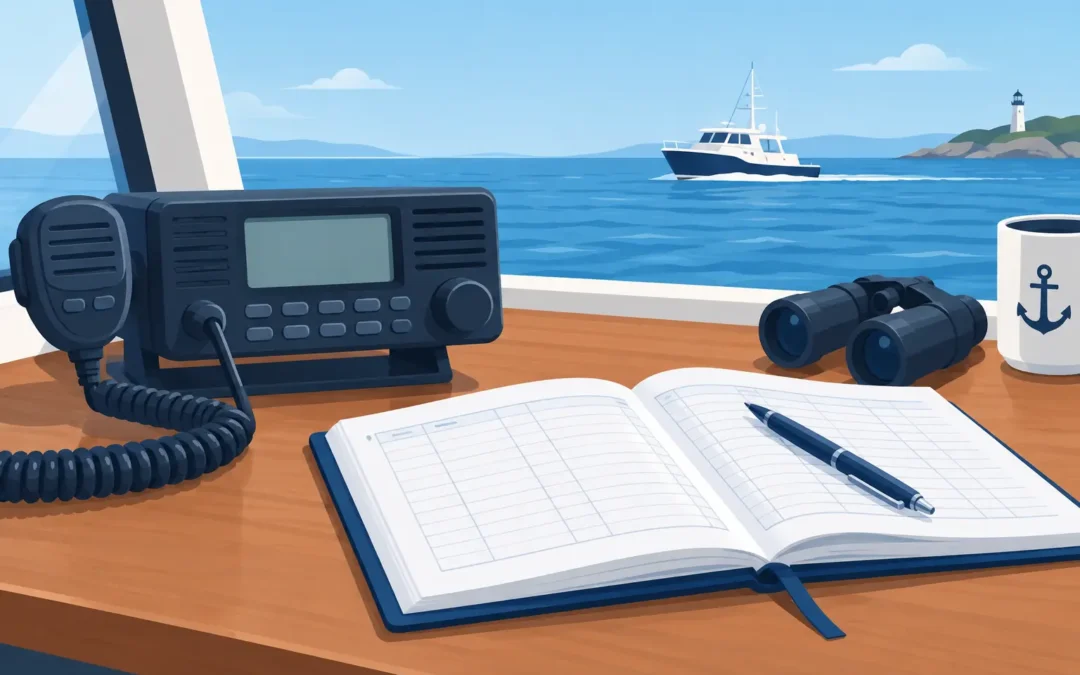
A complete marine radio logbook is not paperwork to catch up on at the end of a shift. It is the written record that can help a crew reconstruct what happened when conditions changed, a safety call was made or a radio fault affected the vessel’s communications.
For commercial operators, marine rescue volunteers and candidates working towards a Coxswain or Master qualification, the standard of the logbook says a great deal about operational discipline. You need to be able to show what was heard, what action was taken, when it occurred and who was responsible. More importantly, you need a log that makes sense to the next person who reads it.
What a marine radio logbook is for
A marine radio logbook records significant radio operations and the condition of a vessel’s communications equipment. Depending on the vessel, its area of operation, the equipment carried and the applicable radio requirements, it may record routine radio checks, distress and urgency traffic, safety broadcasts, watchkeeping events, equipment tests and faults.
The point is not to write down every casual exchange on VHF. A logbook should create a clear operational record of information that may affect the safety of the vessel, its crew or other vessels.
Think about a rough coastal passage when a gale warning is broadcast, visibility drops and the VHF begins transmitting poorly. If there is later a question about the warning received, the time assistance was requested or the fault reported, vague notes such as “radio problems” will not help much. A clear entry can.
Requirements are not identical for every Australian vessel. A small domestic commercial vessel using VHF will not necessarily have the same logging obligations as a vessel carrying GMDSS equipment or operating further offshore. Check the requirements relevant to your vessel, radio station licence, safety equipment and operation. The principle remains the same: record significant communications accurately and promptly.
What a complete marine radio logbook should show
The strongest entries answer the practical questions an assessor, skipper, investigator or relief crew member would ask. What happened? When did it happen? Which radio or channel was used? Who was involved? What did the vessel do next?
For most operational entries, begin with the date and time. Use the time standard required by the vessel’s procedures and stay consistent. If UTC is used, make that clear. If local time is used for day-to-day coastal operations, do not switch halfway through a page without identifying the change.
Then identify the station, vessel or authority involved. Record the relevant channel, frequency or communication method, along with the message received or transmitted. Include the action taken and the name, initials or signature of the person making the entry where required.
A useful entry is factual and uncluttered. It avoids assumptions and does not try to tell a dramatic story. For example:
> 14/06/2026, 0735 local. VHF Ch 16. Received severe weather warning from coast radio for waters south of Point Peron. Master advised. Passage plan reviewed and departure delayed. J.W.
That entry identifies the time, channel, source, message and operational response. It gives the next crew member a reliable picture without unnecessary detail.
Record distress, urgency and safety traffic carefully
Distress communications deserve particular care because the log may become an essential record after an incident. Record the time the message was received, the station or vessel involved if known, its position, the nature of distress and any action taken by your vessel.
If your vessel relays a Mayday, receives a Mayday Relay, maintains a listening watch or is directed to assist, enter those details in sequence. Note instructions from the coordinating authority and the time your vessel was released from involvement. If the distress situation is cancelled or resolved, record the relevant message and time as well.
The same discipline applies to Pan Pan and Securite traffic. An urgency call concerning a person overboard, a disabled vessel or a medical emergency may require your vessel to change watch arrangements, maintain a listening watch or alter course. A safety message may affect a passage plan. The log should show those decisions.
Do not rely on memory after the event. Make the entry as soon as the immediate communications and safety actions allow. During a busy incident, one crew member may be tasked with logging while another handles the radio. That arrangement only works when everyone understands who has the job.
Equipment checks, tests and faults matter
A radio logbook is also an equipment record. Routine checks demonstrate that the crew has verified the communications equipment is available when needed, rather than discovering a fault during an emergency.
The type and frequency of checks depend on the vessel’s equipment and operating procedures. Record the equipment checked, the test performed, the result and any deficiency found. If a fault occurs, write down what failed, when it was identified, what immediate measures were taken and who was notified.
For example, a useful fault entry might state that the fixed VHF receiver had intermittent audio, the handheld VHF was placed on charge and designated as the backup set, and the master or operator was advised. If repairs are arranged or the radio returns to service after testing, add a follow-up entry. A fault is not closed out simply because someone said they would look at it later.
Avoid writing “VHF checked OK” if the check did not actually confirm a working transmission and reception capability. Good records reflect a real check, not a box-ticking exercise.
Keep entries legible, timely and traceable
A paper logbook should be written in permanent ink and kept dry, accessible and protected from loss. Write clearly enough that another crew member can read it underway. If a mistake is made, do not erase it or tear out the page. Rule through the error with a single line so the original remains readable, then write the correct information and initial it if required by vessel procedures.
Electronic log systems can work well, especially where they preserve dates, times, user identity and any corrections. However, an electronic system is only useful if it is available during an incident, backed up appropriately and accepted under the vessel’s operating arrangements. A tablet with a flat battery is not a radio logbook solution.
Whether paper or electronic, avoid leaving blank spaces that could later cause confusion. Complete the entry at the time, then ensure the log is handed over properly at a crew change. The relieving operator should know about outstanding faults, active weather warnings, current search activity or any required listening watch.
Common mistakes candidates should avoid
During oral assessments, candidates often know the wording of a Mayday or Pan Pan call but struggle when asked what they would record afterwards. The issue is usually not a lack of intelligence. It is that they have practised the call, but not the operational process around it.
The most common mistakes are incomplete times, no channel recorded, unclear vessel identification, missing actions and entries made well after the event. Another frequent problem is confusing the radio logbook with the vessel’s general deck log. They may be kept together under an approved vessel system, but radio events still need to be identifiable and complete.
Candidates can also become overly focused on writing every word of a transmission. Record the essential operational information instead. If a vessel gives a position, the nature of its emergency and its intentions, those points matter more than reproducing filler words or informal conversation.
Build the habit before an assessment or busy season
The best way to improve is to use realistic scenarios. Practise receiving a weather warning, reporting a radio fault, logging a Mayday Relay and recording a routine scheduled radio check. Say the scenario aloud, make the entry, then ask whether someone who was not there could understand exactly what happened.
This is valuable preparation for AMSA assessments because it connects radio procedure with command responsibility. Assessors are looking for more than a memorised call format. They want to hear that you can communicate clearly, protect the vessel and maintain accurate records under pressure.
At True North Marine Training, radio revision is most effective when it is tied to the situations you may face at sea, rather than treated as a separate theory subject. A few well-practised, properly written scenarios can quickly expose gaps in timing, priorities and follow-up actions.
A complete logbook will never replace sound judgement or a properly trained operator. It does, however, support both. Keep it current, factual and easy to follow, and it will be there when a routine radio watch becomes something far more serious.