
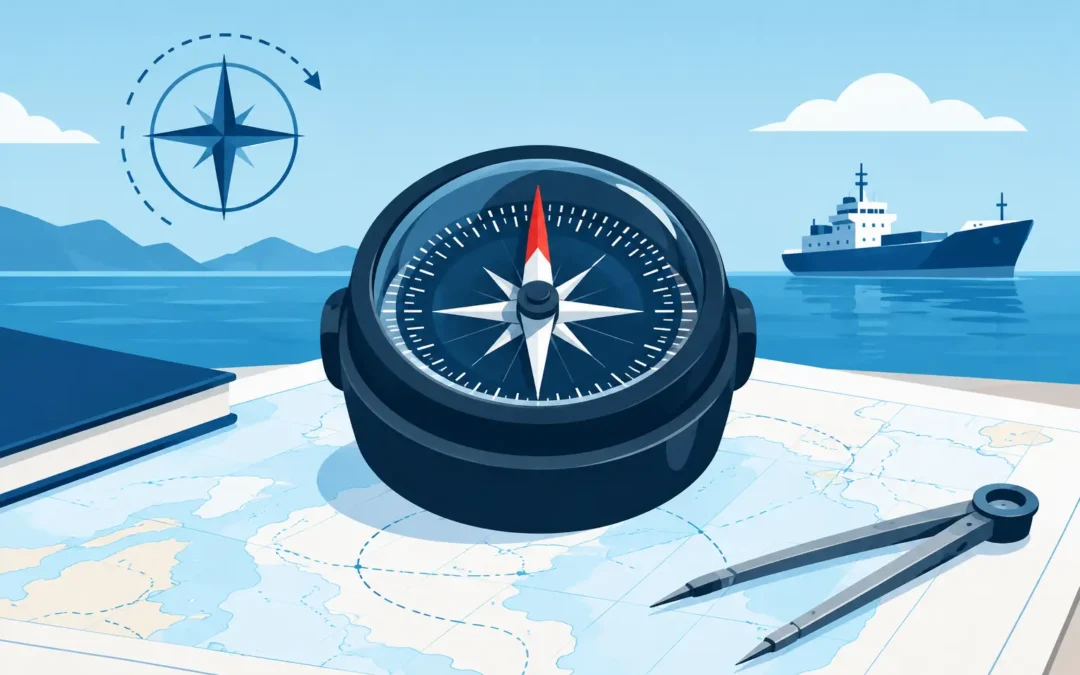
A compass question can look simple on paper, then become surprisingly stressful when an assessor asks you to explain it aloud. The key is not memorising a string of letters. A reliable compass error correction method means knowing what the compass is telling you, what is affecting it, and how to show your working clearly enough to make a safe navigational decision.
For Coxswain and Master candidates, this is more than a chartwork exercise. Compass error affects the course you steer, the bearing you plot and your confidence when electronic systems are unavailable, unreliable or need to be checked against a basic navigational method.
Start with what compass error means
The magnetic compass points towards magnetic north, not true north. It also operates inside a vessel surrounded by steel, electrical equipment and magnetic influences. Those two effects create compass error.
Variation is the angle between true north and magnetic north. It is shown on the chart or derived from the chart’s compass rose using the stated annual change. Variation applies across an area, although its value can change as you move into another charted region.
Deviation is the error caused by the vessel itself. It varies with the vessel’s heading and can be affected by machinery, wiring, speakers, tools, mobile devices or changes to magnetic equipment near the compass. Deviation should be taken from the vessel’s deviation card, where one is available.
Compass error is the combined effect of variation and deviation:
Compass Error = Variation + Deviation
Treat east as positive and west as negative. That signed approach is much safer than trying to remember several different rules under pressure.
The correction method: Compass to True
When you are given a compass course or compass bearing and need to find the true value, work from Compass to Deviation to Magnetic to Variation to True. Many mariners remember this as CDMVT. The order matters because it follows the physical path from the compass on board to the true north reference used on the chart.
Add easterly error and subtract westerly error at each stage. In practical terms:
Compass + deviation = magnetic Magnetic + variation = true
Always write the direction beside the number. A bare “4 degrees” is incomplete. It must be 4 degrees east or 4 degrees west.
Worked example: converting a compass course
Assume the vessel is steering a compass course of 118 degrees. The deviation card shows 3 degrees west on that heading. Charted variation is 8 degrees east.
Start with the compass course of 118 degrees. Apply 3 degrees west deviation, so subtract 3 degrees. The magnetic course is 115 degrees. Then apply 8 degrees east variation, so add 8 degrees. The true course is 123 degrees true.
Written as a calculation:
118°C – 3°W = 115°M 115°M + 8°E = 123°T
This is the kind of clear working an assessor can follow. It also gives you a chance to identify a mistake before it becomes a wrong position or an unsafe track.
The reverse compass error correction method
At sea, you will often have the opposite task. You may plot a true course between two positions on the chart, then need the compass course to steer. In that case, work backwards:
True – variation = magnetic Magnetic – deviation = compass
The wording can be confusing because you are subtracting an east or west value. Keep using signed values and it becomes straightforward.
For example, if your true course is 123 degrees, variation is 8 degrees east and deviation is 3 degrees west, subtract the easterly variation to reach 115 degrees magnetic. Then subtract the westerly deviation. Subtracting west means adding 3 degrees, giving 118 degrees compass.
A good self-check is to reverse your answer. If you convert 118 degrees compass forward again and do not get 123 degrees true, stop and find the error before relying on the course.
Finding compass error from a known bearing
AMSA assessment questions may also ask you to determine compass error rather than simply apply it. The principle is direct: compare a known true bearing with the compass bearing observed on board.
First, obtain a reliable true bearing of a conspicuous charted object. This could be a lighthouse, beacon, headland or a transit. Plot the true bearing from the vessel’s estimated position, or use a known transit bearing where appropriate. Then take the compass bearing of that same object.
Use this relationship:
Compass Error = True Bearing – Compass Bearing
Again, treat east as positive and west as negative.
Worked example: finding the error
Your chartwork shows the true bearing of a lighthouse from the vessel is 045 degrees true. You take a compass bearing of 050 degrees compass.
045°T – 050°C = -5°
The negative result is 5 degrees west. The vessel has 5 degrees west compass error on that heading.
This result makes sense operationally. The compass is reading 050 degrees when the true direction is only 045 degrees, so the compass is reading 5 degrees higher than true.
If charted variation in the area is 2 degrees east, you can find deviation:
Deviation = Compass Error – Variation -5° – +2° = -7°
The deviation is therefore 7 degrees west. That figure should be compared with the vessel’s deviation card, not casually substituted for it. One observation may be affected by poor bearing technique, an uncertain position or a misidentified object.
Choose a method that is suitable for the situation
A compass check is only as reliable as the information used. A clearly charted fixed mark with an accurate position provides a better check than a distant feature that is difficult to identify. A transit can be particularly useful because it gives a known true line. If the vessel lies on the transit and the compass heading is known, the comparison is quick and easy.
Bearings should be taken carefully. Steady the vessel as much as conditions allow, identify the object positively and avoid using a hand bearing compass near a source of interference. On a small commercial vessel, even placing magnetic gear near a compass can change the result enough to matter.
A single bearing is a useful check. A series of checks on different headings is more useful when investigating deviation. Deviation changes with heading, so a result obtained on 090 degrees cannot automatically be assumed to apply on 270 degrees.
Common errors that cost marks
The most common issue is mixing true, magnetic and compass values without labelling them. Put T, M or C beside every figure. This sounds basic, but it prevents a large proportion of calculation errors.
Another issue is using an out-of-date variation. Read the compass rose carefully. The chart may give a variation for a stated year plus an annual increase or decrease. Apply that annual change to the current year before using the variation. If the question provides a variation, use the figure supplied rather than creating extra work.
Candidates also sometimes confuse compass error with deviation. Compass error is the total difference between true and compass north. Deviation is only the vessel-induced component. If variation is present, they are not the same thing.
Finally, do not force a result because it looks familiar. A result of 12 degrees error may be possible, but it should prompt you to check the maths, the object, the charted variation and nearby magnetic influences. Good navigators question information that does not fit the situation.
How to explain this in an oral assessment
An assessor is usually looking for a safe, ordered process rather than a rushed answer. State the reference you have been given, identify whether you are converting Compass to True or True to Compass, then apply deviation and variation with their directions. Say how you would check the result.
You might explain it this way: “I would take the compass bearing of a positively identified charted mark, compare it with the true bearing from the chart, and calculate true minus compass to find compass error. I would then account for chart variation to determine deviation and compare that against the vessel’s deviation card.”
That answer shows calculation skill, chart awareness and practical judgement. It also recognises that the compass is a navigational aid that needs regular checking, not blind trust.
If this subject has become rusty since your course, practise several short questions until the sequence feels natural. At True North Marine Training, one-on-one revision can focus on the exact calculations and oral explanations that need work. A calm, repeatable method is what turns a compass question from a pressure point into an opportunity to demonstrate sound seamanship.