
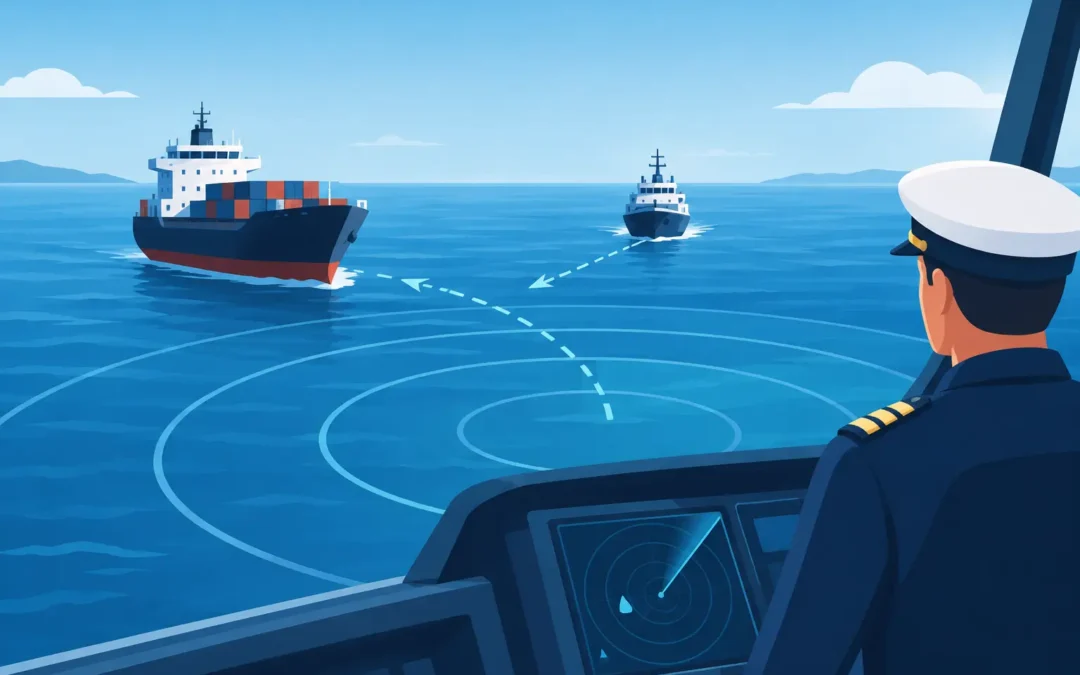
A close-quarters situation rarely begins with one dramatic mistake. More often, it starts with a distracted lookout, an assumed passing arrangement, or a target noticed too late to make a calm and obvious alteration. The best collision avoidance practices are therefore not just about knowing the COLREGs. They are about applying them early, consistently and with enough margin to keep people, vessels and livelihoods safe.
For Coxswain and Master candidates, collision avoidance is also a core assessment topic because it shows an assessor how you think under pressure. You need to explain the rule, recognise the developing risk, make a safe decision and communicate what you would do next. The same approach matters whether you are running a tourism vessel, workboat, fishing boat, rescue vessel or tender in a busy port.
Start with a Proper Lookout
Rule 5 requires every vessel to maintain a proper lookout by sight, hearing and all available means appropriate to the circumstances. It sounds straightforward, but a proper lookout is much more than occasionally glancing through the windscreen.
The person keeping watch must actively scan ahead, abeam and astern as required. They need to identify lights, shapes, vessel type, direction of travel, weather changes, floating hazards and traffic emerging from blind sectors. At night, that also means allowing your eyes to adjust and understanding that shore lights can hide navigation lights or make distances difficult to judge.
A lookout should not be consumed by the chartplotter, radar or mobile. Electronics are valuable aids, but they do not replace a human who is looking out the window and processing the whole situation. On smaller commercial vessels, the Master may be navigating, monitoring machinery, speaking on the radio and supervising passengers. That workload makes planned scan patterns and early decisions even more important.
If visibility is reduced by rain, glare, haze, darkness or spray, increase your level of caution. Slow down to a safe speed, make use of radar where fitted, listen for sound signals and be prepared for a vessel that may not be visible when first detected electronically.
Assess Risk of Collision Early
Risk of collision exists whenever a target maintains a steady bearing while the range closes. This is one of the most useful practical principles a candidate can explain in an oral assessment, but it must be understood rather than repeated by rote.
A steady bearing does not guarantee that a collision will occur, particularly if vessels will pass with a wide margin. However, a small or uncertain change in bearing should be treated seriously, especially at close range, in confined waters or when dealing with a high-speed vessel. If you are unsure, assume risk exists and act in good time.
Use every suitable source of information. Visually, compare the target against a fixed point on your vessel such as a mast, stanchion or window frame. On radar, plot the target or use appropriate tracking information to establish closest point of approach and time to closest point of approach. AIS can assist with identification and broad traffic awareness, but it does not prove another vessel has seen you, will follow the rules or is transmitting accurate information.
The key is to avoid waiting for certainty. A Master who leaves action until the last minute has fewer safe options. Early assessment gives you time to alter course, reduce speed, call another vessel if necessary, and keep the situation clear of everyone else around you.
Apply the Rules, Then Use Good Seamanship
The COLREGs set out who should keep out of the way and who should stand on. Knowing the wording matters, but safe vessel handling depends on understanding the purpose behind each rule.
In a crossing situation between two power-driven vessels, the vessel with the other on her starboard side is generally the give-way vessel. The give-way vessel should take early and substantial action to keep well clear, usually by altering course to starboard to pass astern where it is safe to do so. A small alteration that is hard for the other vessel to detect is rarely a good answer.
The stand-on vessel should maintain course and speed initially. That does not mean holding course blindly while a collision develops. If it becomes apparent that the give-way vessel is not taking appropriate action, the stand-on vessel may take action to avoid collision. When collision cannot be avoided by the give-way vessel alone, the stand-on vessel must act. Rule 2 is always in the background: no rule removes the duty to take all necessary precautions to avoid danger.
Overtaking creates another common trap. A vessel coming from more than 22.5 degrees abaft another vessel’s beam is the overtaking vessel and must keep clear until finally past and clear. Do not try to relabel the situation as crossing simply because the relative bearing changes while closing. If you began as the overtaking vessel, you remain responsible for keeping clear.
Head-on situations require both power-driven vessels to alter course to starboard so they pass port to port. Again, do it early enough to be obvious. In narrow channels, traffic separation schemes, harbour approaches and dredged channels, the practical options may be limited. This is where local knowledge, speed control and a clear plan become essential.
Make Alterations Positive and Obvious
One of the best collision avoidance practices is making an alteration that another competent watchkeeper can readily recognise. A timid five-degree course change may not create enough separation, may be masked by yaw, and may leave the other vessel wondering what you intend to do.
A substantial alteration of course made in good time is usually preferable to a series of small, late changes. But it depends on the surroundings. A large starboard alteration could put you into shallow water, a channel edge, a moored vessel, another traffic stream or a lee shore. Before altering, look beyond the immediate target and consider the complete picture.
Speed is an equally useful collision-avoidance tool. Reducing speed buys time, reduces stopping distance and can make your intentions clearer. It is particularly valuable in restricted visibility, congested anchorages, areas with recreational traffic, or when towing and manoeuvrability are limited. Safe speed is not a number painted on the dash. It changes with visibility, traffic density, vessel handling characteristics, background lighting, sea state and available sea room.
Use Radar, AIS and VHF With Discipline
Radar is most useful when the operator understands its limitations and uses it methodically. Adjust gain, sea clutter and rain clutter correctly so genuine targets are not hidden or confused with noise. Check ranges, bearings and relative movement. If radar plotting is required for your certificate, practise it until you can explain course, speed, CPA, TCPA and the effect of your own manoeuvre without guessing.
AIS is helpful, particularly in busy coastal waters, but it is an aid rather than a collision-avoidance system. Not every vessel carries AIS, transmissions may be incorrect, and a target name on a screen can tempt operators to rely on a VHF call instead of taking timely action.
VHF communications can clarify an uncertain situation, but avoid vague arrangements such as, “I’ll go behind you,” unless both parties clearly identify each other and confirm the intended manoeuvre. Radio does not override the COLREGs, and it should never delay necessary action. In many cases, a clear alteration made early is safer than a lengthy conversation on Channel 16.
Build a Repeatable Watchkeeping Habit
Good decisions are easier when your routine is reliable. Before departure, check navigation equipment, lights, steering, sound signals, weather, tide, local notices and the passage plan. Brief anyone assisting with the watch so they know what to report and when to call you.
When traffic is present, use a simple mental cycle:
- detect the vessel and identify any immediate constraints
- assess bearing, range, relative movement and risk of collision
- apply the relevant rule while considering all surrounding hazards
- make an early, positive manoeuvre or speed reduction where required
- monitor the result until the vessel is finally past and clear
This is not a substitute for judgement. It is a way to stop workload, fatigue or pressure from causing you to skip a vital step. It also gives you a structured way to answer assessment questions. Explain what you would observe, what rule applies, what action you would take, and how you would confirm it worked.
Practise the Decisions Before You Need Them
Candidates often know the basic rules but lose confidence when presented with lights, radar plots, restricted visibility or a rapidly changing scenario. That is normal, especially after a long break between completing a course and presenting for an AMSA final assessment.
The answer is targeted practice, not trying to memorise every possible question. Work through crossing, overtaking and head-on situations until you can describe them clearly. Revise vessel lights and shapes until recognition is prompt. Practise radar plotting by hand if it is part of your assessment, and talk through what you would do if the give-way vessel fails to act.
At True North Marine Training, one-on-one tutoring can help identify where the uncertainty sits, whether it is rules of the road, radar, lights, restricted visibility or the confidence to explain your answer under questioning. The goal is practical: to help you make safe decisions at sea and demonstrate that knowledge clearly when it counts.
A good watchkeeper does not wait for a close call to prove their skill. They see the risk early, make their intentions clear and leave enough room for the unexpected.