
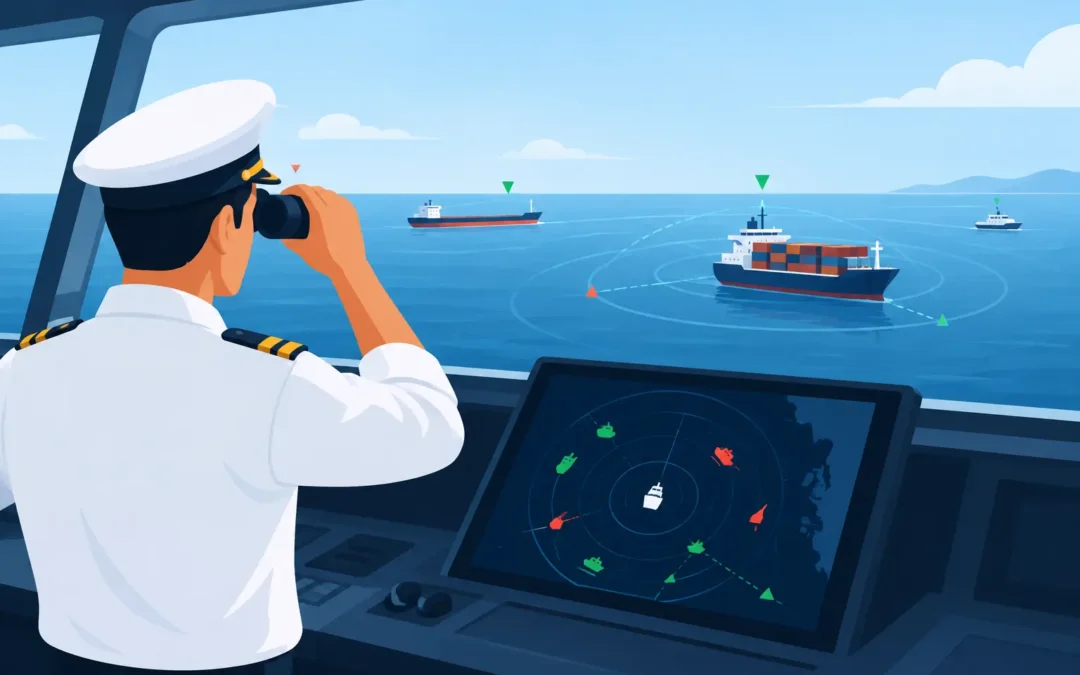
A target appears on the AIS display at 6 miles, passing close down the starboard side. That information is useful, but it is not a collision-avoidance decision by itself. Sound AIS safety operation steps begin with a proper lookout, a clear understanding of what the equipment can and cannot tell you, and the confidence to act early under the Collision Regulations.
For Coxswain and Master candidates, AIS questions often test more than button-pushing. An AMSA assessor may want to know what data AIS transmits, why a target could be missing, how you would respond to an alarm, and why AIS must never replace visual, radar or radio watchkeeping. The best answer connects the equipment to a safe operational decision.
What AIS is there to do
The Automatic Identification System, or AIS, automatically exchanges vessel information by VHF data transmission. Depending on the unit and the information available, an AIS target can show a vessel’s name, MMSI number, call sign, position, course over ground, speed over ground, heading, navigational status, dimensions and destination.
This gives the watchkeeper a faster picture of traffic, particularly in busy approaches, restricted visibility, at night and around commercial shipping. It can help you identify a vessel on radar, anticipate a developing close-quarters situation and make a more informed radio call when communication is genuinely needed.
However, AIS is an aid to navigation. It does not alter the obligations of the master or person in charge. A proper lookout must still be maintained by sight, hearing and all available means. Safe speed, risk assessment, early action and compliance with the Collision Regulations remain the foundation of watchkeeping.
That distinction matters in an assessment and on the water. If you say you would rely on AIS to determine whether a vessel is crossing, overtaking or constrained by its work, expect further questions. You need to confirm the situation by observing the vessel, checking radar where fitted and appropriate, and considering all the circumstances.
AIS safety operation steps before getting underway
A reliable AIS watch starts before the vessel leaves the berth, ramp or anchorage. Treat AIS as part of your normal bridge or wheelhouse checks, not as an item you glance at once the vessel is underway.
First, confirm the unit has powered up correctly and is transmitting or receiving as required for the vessel’s operation. Check that position information is being received from the connected GNSS source. A position on the display that is frozen, clearly wrong or absent makes the AIS information unreliable.
Next, verify the vessel’s static data. This includes the vessel name, call sign, MMSI, dimensions and antenna position. Static details are not something to casually change during a trip. Incorrect programming can create confusion for other vessels and may require correction by an authorised service provider or in accordance with the equipment instructions.
Dynamic information needs closer attention before every departure. Check the navigational status is appropriate to the vessel’s actual condition, such as underway using engine, at anchor, not under command or restricted in ability to manoeuvre where applicable. Enter the voyage-related information required by your equipment and procedures accurately. Do not select a status because it sounds convenient or because it might encourage other traffic to keep clear.
Also make sure the display settings suit the conditions. Excessive range can clutter the screen with targets that have no immediate relevance. Too little range can remove useful warning time. In open water, a broader range may assist with early traffic awareness. In confined waters, a shorter range may give a clearer picture of the vessels that matter now.
Finally, check alarms and target filters. Alarm settings should support the watchkeeper, not create a constant stream of alerts that people learn to ignore. If the unit has a closest point of approach, or CPA, alarm, understand the selected CPA and time-to-CPA limits and whether they are suitable for the vessel’s speed, manoeuvrability and operating area.
Assess targets, not just symbols
An AIS symbol is only the start of the assessment. When a target attracts your attention, compare its AIS data with what you can see and with any radar information available. Ask whether the reported course and speed make sense, whether the target is moving as expected, and whether the displayed position corresponds with the vessel or light you are observing.
Course over ground and heading can differ, especially in strong tidal streams, wind or low-speed manoeuvring. A vessel may show a stable course over ground while its bow is pointing elsewhere. This is one reason a watchkeeper should not make assumptions based on a single AIS vector.
Use the information to build the overall traffic picture. Is the bearing changing? Is the range closing? What is the predicted CPA? Is the other vessel constrained by its draught, fishing gear, towing operation or work alongside a structure? The answers may affect the safest action, but they do not remove your responsibility to avoid collision.
A practical rule is to act early and make your action obvious. Small late alterations can be difficult for another vessel to interpret. If you need to change course or speed, do so in a manner consistent with the Collision Regulations and your vessel’s operating limits. Then continue to monitor the result rather than assuming the risk has passed.
When AIS information is missing or wrong
Not every vessel will appear on AIS. Many recreational vessels, small workboats and some fishing vessels may not carry AIS, may have it switched off, may be out of range, or may be transmitting poor-quality information. A vessel’s AIS transmission can also be obstructed, affected by antenna issues or delayed by system limitations.
The reverse is true as well: an AIS target may be displayed when you cannot immediately see the vessel. It could be obscured by land, weather, another vessel, background lighting or the limitations of your lookout position. Treat that as a reason to investigate, not as proof the risk is remote.
Incorrect AIS data is another real-world possibility. A vessel may have an inaccurate destination, an inappropriate navigational status, a poorly entered draught or an erroneous position source. If AIS data does not match visual or radar observations, give greater weight to the evidence that best reflects the actual situation and increase your caution.
This is a useful oral assessment scenario. Rather than saying, “AIS says it will pass clear”, explain that you would verify the target by all available means, assess risk of collision, maintain lookout and take early action if the situation remains uncertain.
Using VHF without creating confusion
AIS can identify a vessel and provide a likely call sign or name, but VHF should not be used as a substitute for following the Collision Regulations. Arrangements made by radio can be misunderstood, unheard or made with the wrong vessel in a crowded area.
If communication is necessary, first be certain which vessel you are calling. State your own vessel’s identity, identify the other vessel clearly, give your position or relevant landmark, and describe the situation in plain language. Avoid vague calls such as “the vessel on my port bow” when several vessels may fit that description.
Any agreed action should be safe, legal and readily understood. Keep monitoring the situation after the call. A radio conversation does not transfer responsibility, and it does not excuse a failure to keep a proper lookout.
Responding to AIS alarms and faults
An AIS alarm deserves attention, but it does not automatically mean another vessel is at fault or that you must make an immediate turn. Silence or acknowledge the alarm only after you understand what caused it. Check the target, range, bearing trend, CPA, time to CPA and the wider traffic picture.
If the alarm indicates a potential close approach, assess whether there is risk of collision and take appropriate action early. If it is a nuisance alarm caused by settings that do not suit the operating area, adjust the settings thoughtfully. Do not simply disable alarms because they are inconvenient.
For equipment faults, follow the vessel’s safety management procedures and report the defect as required. Consider what navigation and communication capability has been lost, what alternative means are available, and whether the vessel can continue safely. An AIS failure does not necessarily end a voyage, but the decision depends on the vessel, the operation, the weather, traffic density, carriage requirements and available backup equipment.
What assessors want to hear
Candidates can lose marks when they recite AIS data fields but do not explain the safety purpose. A stronger answer describes a sequence: verify the unit and inputs, maintain a proper lookout, assess targets using all available means, recognise AIS limitations, act early to avoid collision, and communicate clearly only when needed.
It also helps to use examples from your own vessel type. A Coxswain running a passenger transfer, a fishing vessel operator working near trawlers, and a Master approaching a busy port will use AIS differently. The principles stay the same, but alarm settings, manoeuvring room and the consequences of delay can be very different.
If you have had time away from study or wheelhouse work, practise explaining these decisions aloud. At True North Marine Training, targeted one-on-one revision can help turn scattered AIS knowledge into clear assessment answers that reflect safe watchkeeping practice. The goal is not to sound rehearsed. It is to show that, when the display gets busy, you know what to check, what to trust and when to act.