
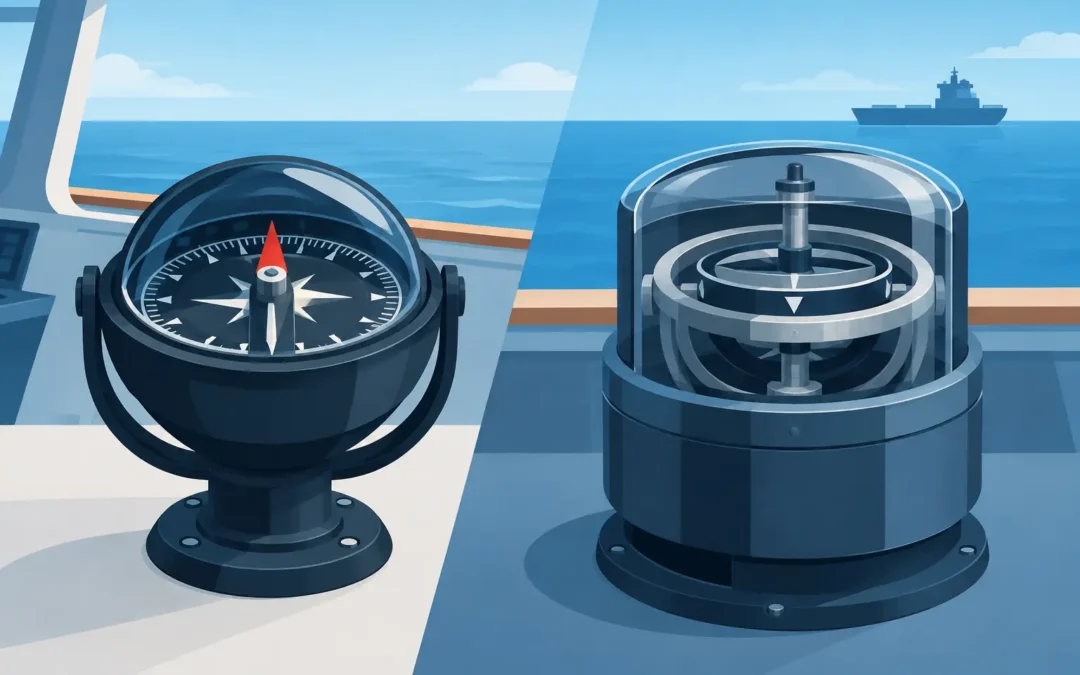
A magnetic versus gyro compass question can sound straightforward in an AMSA oral assessment, until the assessor follows up with: “Which one gives true north?”, “What errors affect it?” or “How would you check it?” The difference is not just theory. It affects the heading you steer, the position you plot and the confidence you can have in your navigation equipment when visibility closes in.
For Coxswain and Master candidates, the key is to explain each compass in practical terms. You need to know what it references, what can make it inaccurate and how you would apply that information on board.
Magnetic versus gyro compass: the fundamental difference
A magnetic compass aligns itself with the Earth’s magnetic field. Its north-seeking end points towards magnetic north, not true north. It does not need electrical power, which is one reason a properly maintained magnetic compass remains an essential item of navigation equipment and a valuable back-up.
A gyro compass uses a rapidly spinning gyroscope, combined with the Earth’s rotation, to settle towards true north. Once settled and operating correctly, it indicates true north rather than magnetic north. This can make it particularly useful for larger vessels, integrated bridge systems, radar and electronic navigation equipment.
Put simply: the magnetic compass gives a magnetic reference, while the gyro compass gives a true reference. Neither should be accepted without question. Both need to be understood, checked and used with their known limitations in mind.
Why true north and magnetic north matter
True north is the direction of the geographic North Pole and is the reference used for charted meridians. Magnetic north is the direction indicated by the Earth’s magnetic field at a particular location. The angle between true north and magnetic north is called variation.
Variation is shown on nautical charts, usually within the compass rose, together with an annual change. It varies according to location and changes over time. A candidate preparing a course to steer needs to identify the current variation correctly, not simply copy an old figure from the chart.
The magnetic compass has another error: deviation. Deviation is caused by magnetic influences on the vessel itself. Steel structure, engines, electronics, wiring, tools, speakers and cargo can all affect the compass. Unlike variation, which relates to the Earth’s magnetic field in a location, deviation is specific to the vessel and can change with heading or following alterations to equipment.
This is why a magnetic compass heading cannot be treated as true without correction. In basic terms, you move between true, magnetic and compass directions by applying variation and deviation correctly. Candidates should be comfortable working through these calculations slowly and showing their method. In an assessment, a sound method matters more than trying to rush an answer from memory.
How a gyro compass works in practice
A gyro compass is not a magnetic device. It contains a gyroscope which, through controlled precession and damping, settles in relation to the Earth’s rotation. The result is an indication of true north.
Because it is electrically powered, a gyro requires time to settle after start-up. On a vessel that has been shut down, lost power or had gyro equipment isolated, it may not be ready for immediate use. Depending on the unit, the settling period can be several hours. The operator must know the equipment’s operating instructions and should not assume a displayed heading is reliable just because the screen is illuminated.
Gyro compasses can also develop errors. Latitude affects their operation because the Earth’s rotational influence changes with latitude. Vessel speed and course can introduce steaming error, particularly at higher speeds or on north-south courses. Mechanical faults, poor maintenance, power interruptions and transmission faults to repeaters can also create misleading information.
That last point is worth remembering. A heading repeater on the bridge wing, at the steering position or connected to radar may not agree with the master gyro. If there is a discrepancy, investigate before relying on it. An assessor may ask what you would do if the gyro heading and magnetic compass heading do not make sense together. A good answer is to compare all available heading sources, consider the known corrections and errors, verify against a visual transit or celestial observation where possible, and report or rectify the fault under the vessel’s procedures.
Advantages and limitations of the magnetic compass
The magnetic compass is simple, independent of vessel power and capable of providing a heading when electronic systems fail. On a small commercial vessel, fishing vessel or rescue vessel, that independence is a serious safety benefit. It is also directly relevant to chartwork, compass-error questions and practical navigation.
Its limitations are equally important. It is subject to variation and deviation, and it can be affected by nearby magnetic objects. A mobile, handheld radio, knife, tool kit or a newly installed electronic device placed close to the binnacle can cause a problem. The compass must be correctly positioned, clearly visible from the steering position and maintained in accordance with the vessel’s requirements.
A magnetic compass should be swung when required to establish the vessel’s deviation on different headings. The resulting deviation information is recorded on a deviation card or table. If major changes have been made to the vessel, such as fitting equipment near the compass or structural work, the previous deviation data may no longer be dependable.
Advantages and limitations of the gyro compass
The major advantage of a gyro compass is that it indicates true north, avoiding the need to apply variation for the displayed heading. It provides a stable reference for radar, autopilots, electronic chart systems and repeaters, and it is not affected by local magnetic influences in the same way as a magnetic compass.
However, the gyro is dependent on power and correctly functioning equipment. It has a settling time, can suffer latitude and speed-related errors, and needs routine checking. A gyro failure can affect far more than the heading display if other systems are receiving gyro input.
For this reason, good bridge practice does not mean choosing one compass and ignoring the other. It means cross-checking. If the gyro says the vessel is heading 090 degrees true, does that agree with the expected magnetic heading after allowing for variation and deviation? Does the radar picture, visual bearings and the vessel’s track support the heading being displayed?
Checks an assessor may expect you to describe
Assessment questions often move beyond definitions. You may be given a scenario involving a suspected compass error, an approaching port, reduced visibility or a conflicting radar and compass indication. Your answer should show a safe, orderly approach.
Start by identifying which compass or display is being used and whether it is referenced to true or magnetic north. Check the gyro has settled, has power and does not show an alarm. Compare the gyro, magnetic compass and any repeaters. Then compare the heading against a known visual transit, a charted leading line, a terrestrial bearing or another reliable reference available at the time.
For the magnetic compass, check that the deviation card is current and that no magnetic items have been placed near the compass. Confirm the chart variation and its annual change are being applied correctly. If the heading information remains suspect, reduce risk: slow down if appropriate, increase the navigational safety margin, use additional means of fixing position, notify the master or relevant person, and record and report the defect.
That is the operational thinking assessors want to hear. A compass discrepancy is not an invitation to guess. It is a reason to verify, communicate and navigate more conservatively.
Common mistakes in compass questions
One common mistake is saying that a gyro compass has no errors. It indicates true north, but it can still have gyro error. Another is saying that the magnetic compass is inaccurate by default. A properly adjusted magnetic compass, with known variation and deviation applied, is a reliable and vital navigational instrument.
Candidates also sometimes mix up variation and deviation. Keep the distinction clear: variation is the difference between true north and magnetic north at a place; deviation is the effect of the vessel’s own magnetism on the compass. If you can explain that plainly, then apply it to a course or bearing calculation, you are well placed.
Finally, do not describe compass checks as a one-off exercise completed before departure. Conditions, equipment status and vessel configuration can change. Good operators maintain a habit of comparing information throughout the voyage.
Prepare for the question behind the question
When revising magnetic and gyro compasses, practise explaining the subject aloud, as you would to an AMSA assessor. Define each compass, identify its reference north, name the likely errors and talk through how you would detect a problem on board. Then work through chart-based variation and deviation examples until your process feels calm and repeatable.
At True North Marine Training, this is the sort of knowledge best built through targeted questions rather than rote learning. Once you understand why the readings differ and how to check them, compass questions become less about memorising terms and more about demonstrating safe command judgement.