
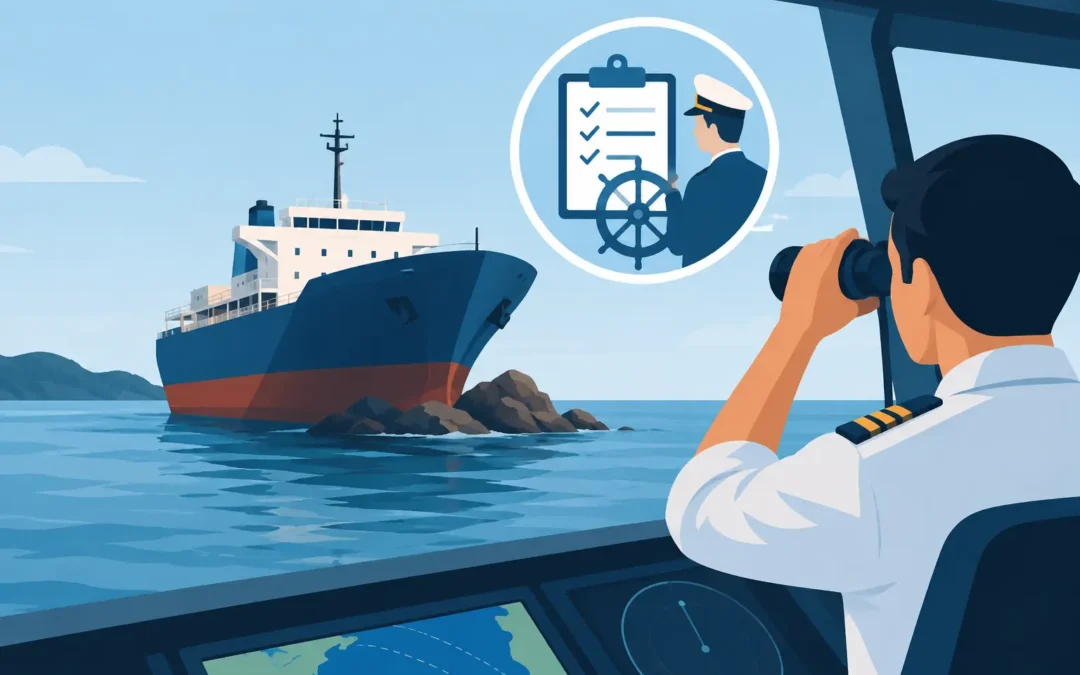
A grounding is rarely caused by one dramatic mistake. More often, it is the final result of small gaps that line up: a rushed passage plan, a position not checked independently, a tide assumed rather than calculated, or a watchkeeper distracted at the wrong time. For Coxswain and Master candidates, grounding incident lessons are valuable because they connect assessment knowledge to the decisions that protect people, vessels and the marine environment.
An AMSA assessor may ask about a grounding as an emergency scenario, but the stronger candidate does more than recite an emergency checklist. They can explain what should have prevented the incident, what immediate actions are appropriate, and how the vessel’s stability, hull condition, tide and surrounding traffic influence the response. That is operational thinking, and it is what makes a capable skipper.
Why groundings still happen
Modern electronics are useful, but a chartplotter is not a substitute for watchkeeping. GNSS can provide a very accurate position, yet it cannot tell you whether the route entered is safe for the vessel’s draught, whether the chart data is suitable for the intended operation, or whether a buoy is where you expect it to be. A display can also be set to the wrong datum, range or orientation, making an apparently simple passage less clear than it should be.
Many groundings occur in familiar waters. Familiarity can encourage shortcuts: no written plan for a short run, no proper check of tidal height, or a decision to cut inside a mark because the weather is worsening or passengers are waiting. Commercial operators can face real time pressure as well, particularly where schedules, loading, fishing operations or a crew change are involved. None of that changes the skipper’s obligation to navigate safely.
The central lesson is that navigation is a continuing process. A passage plan should be monitored from departure to arrival, with the vessel’s position confirmed by more than one method where practical. Visual bearings, depth sounder trends, radar ranges, leading marks and local knowledge all have a place. The method depends on the vessel, equipment and waters, but relying on one electronic screen alone is a poor defence when something goes wrong.
Grounding incident lessons start before departure
Good prevention begins at the chart table or planning screen. Candidates should be comfortable explaining how they identify hazards along a route, allow for the vessel’s draught and squat where relevant, and establish a safe depth for each critical section. That means understanding chart datum, predicted tidal height and the difference between a charted drying height and the depth actually available at the time of transit.
Under keel clearance is not a single number to guess at. It needs a sensible margin for the operation. The required margin may be greater in a swell-prone bar crossing, a narrow channel, soft mud berth, dredged channel or fast-moving tidal area. Vessel motion, heel, squat, changes in draught, sounding accuracy and local conditions can all reduce the clearance you thought you had.
A workable plan also identifies the points where close attention is required. These might include a turn near a shoal, a channel entrance, a crossing area, a confined anchorage or the final approach to a berth. At each point, decide in advance what will confirm the vessel is safe: a clearing bearing, a radar range, a visual transit, an expected depth or a wheel-over position. If the planned check does not match what you see, slow down early and reassess.
For an oral assessment, avoid saying only that you would “check the chart”. Explain what you are checking and why. An assessor is looking for the link between the charted information, the tide, the vessel’s characteristics and your practical decision.
The human factors that undermine a sound plan
A plan can be technically correct and still fail if it is not communicated. Crew need to know the intended route, the hazards, the lookout arrangements and when they should raise a concern. On a small vessel, this may be a short briefing before departure. On a larger operation, it may be a more formal passage plan and bridge team discussion.
Fatigue, distraction and poor communication regularly feature in incident reports. A skipper managing a radio call, a passenger issue, a deck operation and the helm at the same time has less capacity to monitor the vessel’s track. Good watchkeeping includes recognising when workload is building and taking simple action before it becomes unsafe, such as reducing speed, assigning a lookout or delaying a non-essential task.
If the vessel grounds: priorities and decisions
The response to a grounding is situation-dependent. A light contact at low speed in sheltered water is different from a hard grounding on a falling tide, exposed reef or shipping channel. In either case, the first priority is people. Account for those onboard, assess injuries, make the vessel safe and establish whether there is an immediate danger from flooding, fire, weather, traffic or the vessel moving further onto the obstruction.
The next priority is to assess the vessel without making the situation worse. Stop engines or propulsion if continuing to run them may cause damage, check for water ingress, sound bilges and tanks as appropriate, and assess the vessel’s position, tide and sea state. Take accurate positions and record the time. If fuel, oil or other pollutants may be released, environmental protection becomes an urgent part of the response.
One of the most common weak answers in an assessment is, “I would reverse off.” That may be appropriate in some circumstances, but it is never an automatic first move. Attempting to refloat without understanding the damage, tide, bottom type or hull stresses can worsen flooding, rupture a tank or leave the vessel broadside to seas. A vessel that has touched hard may have compromised steering, propulsion or watertight integrity even if it initially appears sound.
Candidates should be ready to explain the need to communicate with the relevant authorities and seek assistance when required. The appropriate urgency call depends on the level of danger. A distress situation, where there is grave and imminent danger and immediate assistance is required, demands a different response to an urgency situation where a serious problem exists but there is no immediate threat to life. Your radio procedure, position reporting and ability to give clear details matter just as much as knowing the words.
The stability question after a grounding
Grounding scenarios often lead assessors into stability because the consequences can change quickly. If a compartment is damaged and floods, the vessel may develop list or trim, lose freeboard and become less stable. Free surface effect in partly filled tanks can further reduce stability. Moving people, stores or equipment without thinking may make matters worse.
The right response is not to offer a one-size-fits-all fix. Explain that you would assess the vessel’s condition, control flooding where possible, avoid unnecessary weight shifts, and follow the vessel’s emergency procedures and stability information. If evacuation is necessary, it must be managed in a way that does not create a second emergency. Launching survival craft, transferring people or gathering everyone to one side can affect stability, especially on smaller vessels.
This is why grounding knowledge belongs alongside practical revision of stability, watertight integrity, emergency communications and damage control. These subjects are not isolated assessment boxes. They are linked decisions made under pressure.
Turning the incident into better watchkeeping
After any grounding or near miss, the useful question is not simply who made the final error. Ask what barriers were missing or ineffective. Was the plan incomplete? Was the safe depth calculation wrong? Did nobody challenge an unexpected position? Was the lookout unable to see the relevant hazard? Did time pressure lead to a decision that would not have been accepted in calmer circumstances?
A proper review should result in a change that can be used next time. That could be clearer route marking, better tidal planning, a minimum under keel clearance policy, a more disciplined position-fixing routine or a crew briefing before entering confined waters. The aim is to improve the system, not merely to fill out an incident report.
For candidates returning to study after a period at sea, grounding scenarios are an excellent way to test whether navigation knowledge is still practical. Talk through a real route. Calculate the available depth. Identify the last safe point to turn around. Then explain exactly what you would do if the vessel touched bottom. If any part of that explanation feels uncertain, targeted one-on-one revision can turn a vague answer into a calm, structured response.
At True North Marine Training, this is the standard worth working towards: not just passing an assessment, but being able to make a sound decision when the chart, tide and pressure of the moment all demand your full attention.