
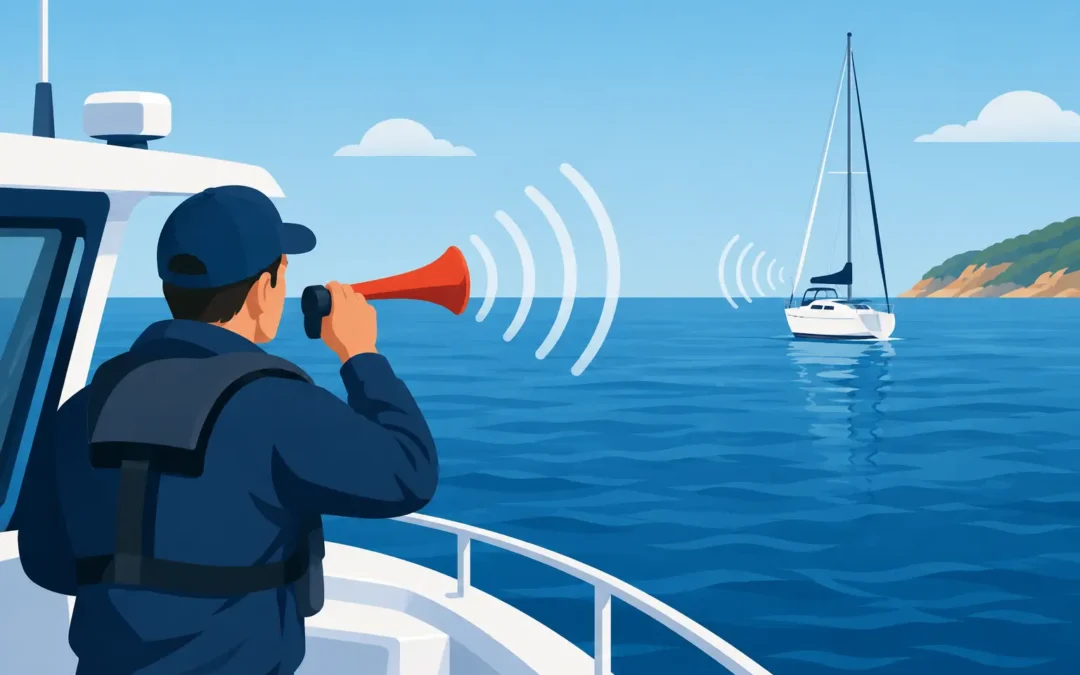
A whistle signal is not something to leave until you are close enough to see the other skipper’s expression. Candidates often ask, “when use sound signals?” The practical answer is whenever the Collision Regulations require them, particularly when you are manoeuvring in sight of another vessel, operating in restricted visibility, or need to attract attention or signal distress. Knowing the correct signal matters, but knowing its purpose matters just as much.
For Coxswain and Master candidates, sound signals are a common oral-assessment topic because they test more than memory. An AMSA assessor may want to know what signal you would make, when you would make it, what the other vessel may be doing, and what safe action follows. A good answer connects the rule to the situation on the water.
When to use sound signals under the Collision Regulations
The sound signal rules sit mainly in Rules 32 to 37 of the International Regulations for Preventing Collisions at Sea. In Australian waters, they apply alongside your responsibility to keep a proper lookout, proceed at a safe speed, assess risk of collision and take early, substantial action where needed.
A sound signal never gives you a right of way. If another vessel sounds one short blast, that tells you it is altering course to starboard. It does not mean the manoeuvre is safe, that you can stop looking out, or that you should assume the vessel will do exactly what you expect.
For assessment purposes, begin with the basic timing:
- A short blast lasts about one second.
- A prolonged blast lasts from four to six seconds.
The signal must be made with an efficient sound-signalling appliance. On a small vessel, that may be a horn or whistle suitable for the vessel, but it must be audible and ready to use. Do not rely on yelling across the water, revving the engine or calling on VHF as a substitute for a required sound signal.
Manoeuvring signals when vessels are in sight
Rule 34 applies when power-driven vessels are in sight of one another and manoeuvring. The three basic whistle signals are simple, but candidates can lose marks when they fail to explain what the signal refers to.
One short blast means, “I am altering my course to starboard.” Two short blasts mean, “I am altering my course to port.” Three short blasts mean, “I am operating astern propulsion.” These are statements of your vessel’s action, not instructions for the other vessel.
Picture a ferry leaving a berth, a workboat crossing a harbour channel, or a vessel approaching a congested marina fairway. If the master is using the whistle to indicate a course alteration, it helps other vessels understand the intended movement. The signal supports safe navigation, but it does not replace a proper visual lookout, radar use where fitted, or clear VHF communication where appropriate.
The danger signal
At least five short and rapid blasts are the danger or doubt signal. Use it when you do not understand the other vessel’s intentions, when you doubt whether it is taking sufficient action to avoid collision, or when its actions appear unsafe.
This is a signal worth treating seriously rather than as an exam fact. If a vessel is standing into your track in a narrow harbour entrance and its intentions are unclear, five or more short rapid blasts can draw immediate attention to the developing risk. Follow that signal with safe collision-avoidance action. Sounding the whistle is not enough if the situation requires you to slow down, stop, alter course, or take other action to keep clear.
Narrow channels and bends
There are additional signals for narrow channels and fairways. A vessel intending to overtake another vessel in a narrow channel sounds two prolonged blasts followed by one short blast if it intends to overtake on the other vessel’s starboard side. Two prolonged blasts followed by two short blasts indicates an intention to overtake on the other vessel’s port side.
The vessel being overtaken, if it agrees, responds with one prolonged blast, one short blast, one prolonged blast and one short blast. If there is doubt, do not treat silence as agreement and press on. Reduce the risk first.
When approaching a bend or an area of a narrow channel where other vessels may be obscured, sound one prolonged blast. Any vessel hearing that signal around the bend should answer with a prolonged blast. This is particularly relevant in rivers, dredge areas, confined port waters and channels bordered by mangroves, wharves or terrain that blocks visibility.
Sound signals in restricted visibility
Restricted visibility means fog, heavy rain, smoke, dust storms, haze or any condition where visibility is reduced. It is not limited to a thick offshore fog bank. If you cannot properly see vessels or navigation lights at the required range, you need to think about Rule 35, safe speed and radar capability.
A power-driven vessel making way through the water sounds one prolonged blast at intervals of not more than two minutes. If a power-driven vessel is underway but stopped and making no way through the water, it sounds two prolonged blasts in succession, separated by about two seconds, at intervals of not more than two minutes.
That distinction is regularly tested. “Underway” does not mean moving. A vessel is underway when it is not at anchor, made fast to the shore or aground. A vessel can therefore be underway while stopped in the water and making no way.
A vessel not under command, restricted in its ability to manoeuvre, constrained by its draught, sailing, fishing, or towing or pushing another vessel sounds one prolonged blast followed by two short blasts, again at intervals of not more than two minutes. A vessel being towed, or the last vessel of a tow where more than one is involved, sounds one prolonged blast followed by three short blasts, where practicable.
The reason behind these patterns is operational awareness. In poor visibility, another vessel may hear you before it sees you. Your signal gives it information about the kind of vessel it may be meeting, but neither skipper should assume that hearing a signal gives an accurate range, bearing or collision solution. Slow down, listen carefully, use all available means to assess risk and be prepared for close-quarters action.
Signals at anchor and aground
An anchored vessel must ring a bell rapidly for about five seconds at intervals of not more than one minute. A vessel of 100 metres or more must also sound a gong rapidly in the after part of the vessel immediately after ringing the bell.
A vessel aground makes the anchor signal and, immediately before and after the rapid ringing, gives three distinct strokes on the bell. If the vessel is 100 metres or more, the gong requirement also applies. These signals are designed to warn approaching traffic that the vessel is stationary and may present a serious obstruction.
Vessels under 12 metres are not required to make these particular signals, but they must make some other efficient sound signal at intervals of not more than two minutes. In practice, small-vessel skippers should not use the exemption as a reason to become quiet and hard to detect in poor visibility.
Attention and distress signals
Rule 36 allows you to use any light or sound signal that cannot be mistaken for an authorised signal to attract another vessel’s attention. This may be useful where an immediate warning is needed. The key limitation is that you must not create confusion by copying navigation lights, recognised whistle signals or distress signals.
Distress signals are different again. They indicate that a vessel is in grave and imminent danger and requires immediate assistance. Examples include a continuous sounding with any fog-signalling apparatus, a Mayday call, red rockets or flares fired at short intervals, or the SOS signal. They are not tools for a breakdown that can be managed safely, a late arrival, or a minor inconvenience.
If you declare distress, give a clear position, the nature of the emergency, the assistance required and the number of people on board. Then continue to manage the vessel and crew. A radio call, visual signal and sound signal may all form part of the response depending on the circumstances.
How to answer a sound-signal question in an AMSA assessment
Avoid reciting a sequence of blasts without context. Start by identifying the operating condition: vessels in sight, restricted visibility, narrow channel, at anchor, aground, attention or distress. State the exact signal, then explain the operational action you would take.
For example, if asked what you would do after hearing one prolonged blast followed by two short blasts in fog, identify it as the signal used by a vessel such as a fishing vessel, sailing vessel, vessel restricted in ability to manoeuvre or vessel constrained by draught. Then explain that you would maintain a heightened lookout, assess the situation using all available means, proceed at safe speed and avoid making assumptions about the other vessel’s position or intentions.
This approach shows an assessor that you can apply the rule under pressure, not merely recall it from a question bank. If you have had time away from study or have not used these signals regularly in your current job, targeted revision can rebuild that confidence quickly. True North Marine Training works through these practical scenarios one-on-one, including the follow-up questions assessors often ask.
Sound signals are short, but the decisions around them are not. Learn each pattern accurately, practise saying the purpose out loud, and always connect the signal to safe seamanship. That is the habit that will serve you in an assessment and on the water.