
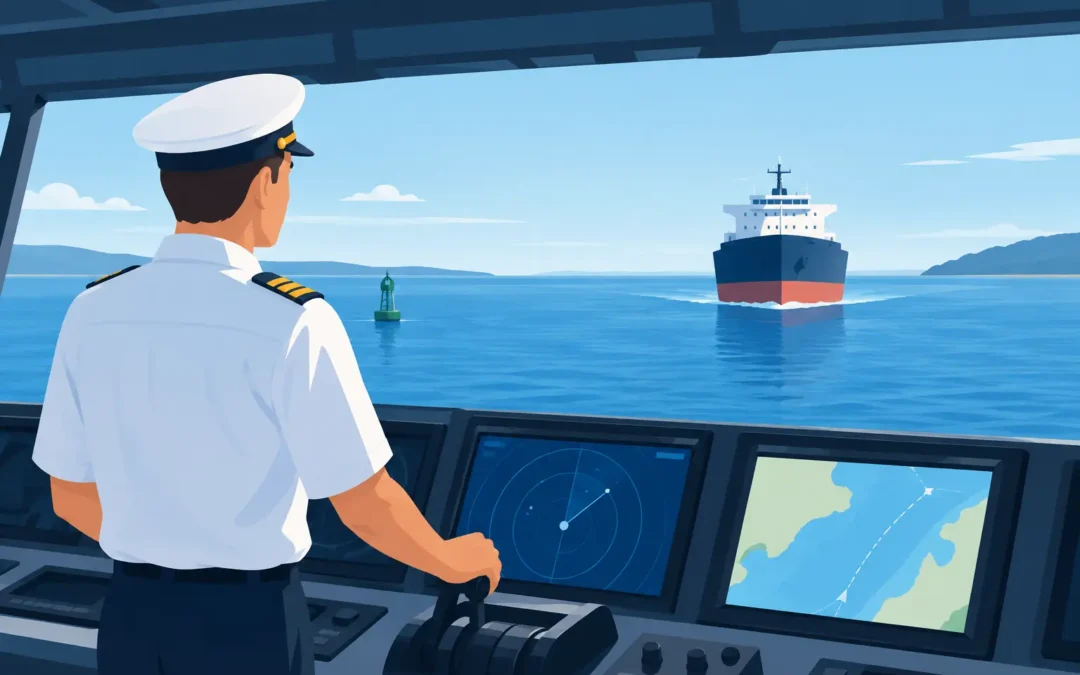
A close-quarters manoeuvre can look straightforward from the wheelhouse until wind, tide, restricted water and a busy berth begin working against you. This ship handling training guide is designed for Coxswain and Master candidates who need to turn practical experience into clear, safe answers during an AMSA assessment.
Many candidates have spent years working on the water, then find themselves out of practice after a gap in training or while building the sea service required for their qualification. The issue is rarely a complete lack of knowledge. More often, it is knowing how to explain your plan, identify the risks, and show an assessor that your decisions are measured rather than reactive.
What ship handling training should prepare you to do
Ship handling is not simply steering a vessel from A to B. It is the controlled management of a vessel’s movement in changing conditions, with proper allowance for the vessel, crew, waterway and task at hand. For an AMSA candidate, that means being able to discuss what you would do before the manoeuvre, while it is underway, and when it does not go to plan.
An assessor may give you a scenario rather than ask for a textbook definition. You could be asked how you would berth a vessel with a strong crosswind, turn in confined water, recover a person overboard, approach a mooring, or handle an engine failure near a channel. A good response is not a rushed set of helm orders. It starts with assessment, preparation and communication.
The expected standard will vary with the certificate and operational context. A Coxswain working a small commercial vessel does not handle a vessel in exactly the same way as a Master operating a larger vessel with different propulsion, loading and passage constraints. The safety principles remain the same, but the detail must suit the vessel and the situation.
Start with the vessel, not the manoeuvre
Before you can describe a safe approach, you need to understand how the vessel behaves. Candidates should be comfortable discussing the characteristics that influence control, including displacement, draft, freeboard, windage, propulsion arrangement, rudder response and turning circle.
A high-sided passenger vessel may be heavily affected by wind long before its skipper feels the current. A loaded workboat may carry momentum that makes a late correction ineffective. A single-screw vessel may show significant propeller walk when going astern, while a twin-screw vessel may turn effectively using differential thrust. Bow thrusters can assist, but they are not a substitute for sound planning and may lose effectiveness at speed or in difficult conditions.
Knowing these factors matters because assessors want to hear your reasoning. Rather than saying, “I would come alongside slowly”, explain how you would judge the wind and current, choose an approach angle, maintain steerageway, and keep enough room to abort safely. That shows operational understanding.
Use a proper manoeuvring plan
A concise plan gives you a reliable structure under questioning. Before berthing, unberthing or entering restricted waters, consider these practical points:
- the vessel’s draft, air draft, manoeuvring limits and stopping distance;
- the weather, tide, current, visibility and available sea room;
- local traffic, navigation marks, port requirements and likely hazards;
- crew briefing, lines, fenders, communications and personal protective equipment; and
- a clear abort point or alternative plan if the approach becomes unsafe.
The abort point is often missed. There is no prize for continuing an unstable approach to a berth. A competent Master recognises when speed, angle or environmental forces have taken the vessel outside safe limits, then backs away, regains control and tries again when ready.
Control speed without losing control of the vessel
Slow speed is central to close-quarters work, but “as slow as possible” is not always the safest answer. A vessel still needs sufficient water flow over the rudder, or enough propulsion effect, to respond predictably. In a strong cross-current, going too slowly may allow the vessel to set sideways before corrective action can take effect.
This is where candidates should show judgement. Use the minimum speed needed to maintain control, then make small, early corrections rather than large, late ones. Avoid excessive use of power near a berth, especially where wash, crew safety, moored vessels or shallow water are concerns.
When discussing engine movements, explain the purpose behind them. A short burst ahead may maintain steerage; a controlled astern movement may check momentum; neutral may be used to assess the vessel’s natural set. The exact technique depends on propulsion type and conditions. What matters is that every movement is deliberate and observed.
Think ahead of the vessel
Ship handling is a forward-planning exercise. By the time a vessel’s bow has started falling off in the wind, the conditions causing it may have been apparent for some time. Build the habit of looking outside, checking your position, and anticipating the next effect rather than concentrating only on the immediate helm response.
This is particularly relevant when turning in confined water. Consider where the wind is likely to push the bow and stern, whether current will set the vessel during the turn, and how much room is needed for the vessel’s pivot point to move. The pivot point changes with headway and sternway, so your explanation should reflect the vessel’s direction of travel.
If you are unsure of available room, slow down early and reassess. Good ship handlers protect their options. They do not commit a vessel to a manoeuvre simply because it was the original plan.
Communication is part of ship handling
A manoeuvre can fail even when the person at the controls understands the vessel perfectly. Poor communication between the wheelhouse and deck crew creates avoidable risk, particularly during berthing, anchoring, tow work or person-overboard recovery.
In an assessment, be ready to explain how you would brief the crew. Confirm the intended manoeuvre, line-handling arrangements, communications method, hazards and the instruction to report any concern immediately. Closed-loop communication is useful: the order is repeated back, acknowledged, then confirmed when completed.
Clear language also helps when communicating with other vessels and vessel traffic services. State your intentions early where appropriate, listen carefully, and avoid assumptions. A radio call does not remove the need to keep a proper lookout or comply with the collision regulations.
For a person-overboard situation, your priorities are equally clear: raise the alarm, maintain visual contact, mark the position if practical, manoeuvre safely, prepare recovery equipment and manage the risk to the crew. The recovery method will depend on vessel design, weather, sea state and the casualty’s condition. An answer that recognises those limits is stronger than one that promises a single technique will suit every scenario.
Practise the questions assessors actually ask
Reading notes is useful, but ship handling knowledge is tested most effectively through spoken scenarios. Ask yourself questions aloud: What would I check before entering this harbour? How would I approach this berth with wind off the dock? What would make me abandon the approach? What changes if I lose propulsion? Why have I chosen this course and speed?
Then make your answer operational. Start with the risk assessment, describe your preparation, explain the manoeuvre step by step, and finish with your contingency. If a calculation is involved, such as under-keel clearance, tidal height or squat considerations, show the working and explain what the result means for the vessel.
This style of revision exposes weak areas quickly. You may know the rules for lights and shapes but hesitate when applying them to an overtaking situation. You may understand stability theory but need more practice explaining how free surface effect affects a vessel during a turn. Targeted question-based practice is more useful than repeatedly revising subjects you already know well.
At True North Marine Training, one-on-one tutoring is built around this kind of practical assessment preparation. Individual sessions allow candidates to work through the knowledge areas that need attention, including ship handling, emergency response, navigation, stability and radar plotting, without being lost in a generic classroom pace.
Build confidence through safe decision-making
Confidence in ship handling does not come from pretending that every manoeuvre will be perfect. It comes from knowing your vessel, recognising developing risk, communicating clearly and being prepared to stop or reset when conditions change.
Before your assessment, practise explaining real manoeuvres you have carried out, as well as unfamiliar scenarios. Keep your answers calm and structured. An assessor is looking for a person who can make sound decisions when there is pressure on the bridge, on deck and around the vessel.
The best preparation is not memorising clever phrases. It is developing the habit of pausing, assessing and choosing the safest workable option – the same habit that protects people, vessels and livelihoods once you are back on the water.