
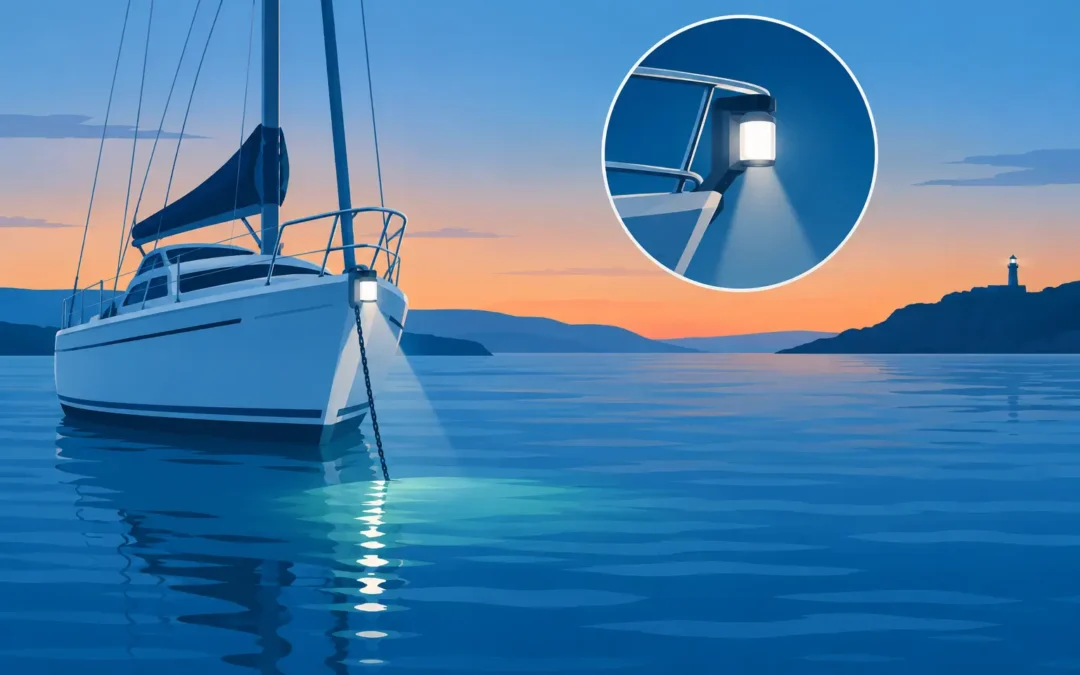
A quiet night at anchor can become a close-quarters situation quickly when another vessel cannot work out whether you are underway, fishing or stationary. That is why anchor light rules are more than a theory question for a Coxswain or Master assessment. They are a basic part of being seen, understood and avoided by other vessels.
For Australian commercial and recreational operators, the practical test is simple: if you anchor after dark, can another vessel see that you are at anchor, identify your position and take safe avoiding action? The detail matters because the required lights change with vessel length and circumstances, while local requirements can also apply in particular ports, channels and waterways.
When anchor lights must be displayed
Under the International Regulations for Preventing Collisions at Sea, reflected in Australian maritime requirements, lights are required from sunset to sunrise. They may also be shown during periods of restricted visibility, such as fog, heavy rain or smoke haze, and at any other time when visibility demands it.
A vessel that is properly anchored is not making way through the water and is not under command for navigation in the usual sense. Its lights must communicate that clearly. A white all-round anchor light tells other vessels they are looking at a stationary vessel. It does not give you a right to be ignored, nor does it remove the need for a proper anchor watch.
In an oral assessment, candidates are often asked a scenario rather than a rule number. For example: “You have anchored overnight outside a harbour. What lights do you show?” A strong answer begins with the vessel’s length, then describes the correct lights and any relevant exception. It should also acknowledge whether the location is safe and appropriate for anchoring.
Anchor light rules by vessel length
The requirements are based on the vessel’s length overall. Knowing the broad categories is useful, but candidates should be able to explain what the lights achieve, not just recite a memorised phrase.
Vessels under 50 metres
A vessel less than 50 metres in length at anchor may display one all-round white light where it can best be seen. “All-round” means visible through 360 degrees. The light needs to be mounted and positioned so it is not hidden by a wheelhouse, mast, tender, awning or deck gear.
On a small vessel, this is commonly referred to as an anchor light. In practice, check that it is a proper navigation light suitable for the vessel and that its battery supply is reliable for the full period of darkness. A portable camping lantern hanging in the rigging is not an acceptable substitute unless it meets the relevant lighting requirements.
Vessels of 50 metres or more
A vessel 50 metres or more in length at anchor must show two all-round white lights. The forward light is placed higher than the aft light, and the aft light is at or near the stern and lower than the forward light.
This vertical and longitudinal arrangement helps another vessel judge the anchored vessel’s size and orientation. It is particularly relevant around commercial anchorages, dredging work sites and busy approaches where large vessels may be anchored near smaller craft.
Vessels of 100 metres or more
A vessel 100 metres or more in length must also use available working or equivalent lights to illuminate its decks. These lights are not a replacement for the prescribed anchor lights. Their purpose is to make the vessel’s overall presence more obvious.
For candidates working towards higher-level qualifications, this is a good example of why operational knowledge must go beyond the smallest vessel you have personally operated. A Master needs to recognise the light configuration of larger vessels and understand what it means when meeting or passing at night.
Day shapes still matter
Anchor signals are not only about night operations. During daylight, a vessel at anchor is required to exhibit one black ball in the fore part where it can best be seen.
The black ball is easily overlooked in study because it is not as visually familiar as navigation lights. Yet it is a common assessment topic. If you are asked about a vessel at anchor, include the day shape where relevant. It demonstrates that you understand the rule operates over a full 24-hour period, not only after sunset.
Small vessels have some exemptions from displaying shapes, but do not let an exemption become a habit of poor seamanship. If your operation, vessel size or local conditions make the signal appropriate, displaying it supports clear communication with other water users.
The limited exception for very small vessels
A vessel less than seven metres in length is not required to show the prescribed anchor light or day shape when it is not in, or near, a narrow channel, fairway, anchorage or an area where other vessels normally navigate.
This exception is narrow and should be treated carefully. It might apply to a dinghy anchored well clear of traffic in a quiet bay. It is unlikely to be a sensible defence for a small boat anchored near a channel entrance, mooring area, ferry route or popular ramp access after dark.
The key words are location and traffic. If other vessels could reasonably pass nearby, make your vessel visible. Showing an anchor light is often the safe and professional choice even where a technical exemption may apply.
Do not confuse an anchored vessel with an aground vessel
A vessel aground has additional signals because it presents a different and potentially more serious hazard. Along with the lights and shapes required for a vessel at anchor, an aground vessel must show two all-round red lights in a vertical line. By day, it displays three black balls in a vertical line.
The distinction is worth practising aloud. An anchored vessel is intentionally held by its anchor. An aground vessel is resting on the seabed or otherwise stranded. If you state only “white anchor light” when describing an aground vessel, your answer is incomplete.
There are exemptions for smaller vessels in some circumstances, but an assessor is generally looking for your recognition of the primary signals and the hazard they communicate. In real operations, your priorities also include checking for flooding, hull damage, pollution risk, tide, weather and the safety of people on board.
Common anchor-light mistakes on the water
The most common failures are practical rather than technical. A light may be fitted but obscured by an inflatable tender. It may be switched on but too low to be seen over a cabin roof. The battery may be flat by 0200, just when a vessel returning from fishing or a late ferry needs to identify your position.
Another mistake is displaying the wrong combination of lights. A vessel at anchor should not show sidelights, a sternlight or a masthead light simply because those lights are part of the normal navigation panel. Those are underway lights and can give another skipper the wrong impression of your status.
Before settling for the night, check the anchor light from different points on deck. Consider the swing circle, the nearest navigation route, expected weather and whether the vessel may rotate with wind or tide. If you are operating commercially, make the check part of your watchkeeping routine and record it where your vessel procedures require it.
How to answer anchor light questions in an assessment
When answering an assessment question, avoid rushing straight into a single light description. Start by identifying the situation: at anchor, aground, underway or restricted in ability to manoeuvre. Then state the vessel length, time of day and location if it affects the rule.
A clear answer might sound like this: “For a vessel under 50 metres at anchor at night, I would show one all-round white light where it can best be seen, and by day one black ball forward. If the vessel were under seven metres, there is a limited exemption only when clear of channels, fairways, anchorages and areas normally used by other vessels.”
That approach shows the assessor you can apply the rule rather than rely on a flashcard. It also gives you room to discuss safety measures such as maintaining an anchor watch, monitoring VHF, confirming holding position and preparing to respond if the vessel drags.
Anchor light questions are often straightforward once you have worked through real examples. Practise them until the answer feels like an operational decision, not a line from a book. If you are preparing for an AMSA final assessment and want to sharpen that confidence under questioning, targeted one-on-one revision with True North Marine Training can help turn the rule into a response you can deliver calmly on the day.