
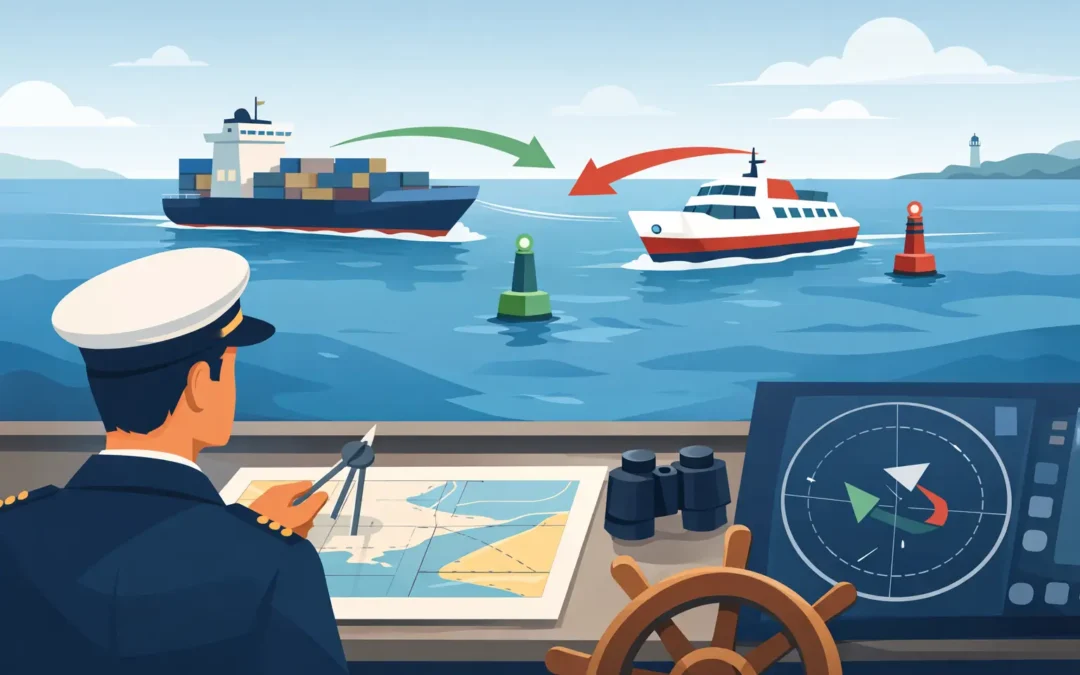
A vessel rounds a headland at dusk. Another set of navigation lights appears ahead, the radar return is closing, and an assessor asks one simple question: “What are you going to do?” This is where collision regulations rules stop being a theory subject and become a test of whether you can make a safe, early and confident command decision.
For Coxswain and Master candidates, the collision regulations are often examined through practical scenarios rather than a request to recite rule numbers. You may be shown lights, given relative bearings and courses, asked to explain your obligations in a crossing situation, or challenged on what changes when visibility closes in. The answer must show more than recall. It must demonstrate good seamanship, a proper lookout and decisive action that another vessel can understand.
Why collision regulations rules matter in an assessment
The International Regulations for Preventing Collisions at Sea, commonly called the COLREGs, establish the rules vessels use to avoid collision. In Australian operations, they sit alongside applicable national, state and local requirements, including port rules and vessel operating procedures. A skipper cannot rely on having the technical right of way if their actions do not prevent an incident.
Assessors are looking for operational judgement. They want to hear that you understand the whole situation: the vessel type, day shape or lights displayed, relative movement, sea room, traffic density, weather, visibility and your own vessel’s manoeuvring limits.
A correct answer therefore usually starts with observation. Before deciding whether you are the give-way or stand-on vessel, establish a proper lookout by sight, hearing and all available means. Use radar properly if fitted and appropriate, but do not treat it as a substitute for looking out the wheelhouse window. In a small commercial vessel, a fishing boat, a ferry or a rescue craft, a few seconds of inattention can erase the margin you thought you had.
Start with risk, not right of way
A common assessment weakness is rushing straight to, “I am the stand-on vessel.” That may be technically relevant, but it is not the first priority. The first question is whether risk of collision exists.
Constant bearing with decreasing range is the classic warning sign. In practice, a steady compass bearing, a stable visual bearing, radar plotting, automatic radar plotting aid information where fitted, or simply an approaching vessel growing larger can all indicate danger. If you are uncertain, treat the risk as existing until you can clearly establish otherwise.
Candidates should be ready to explain how they would assess the situation. Check the other vessel’s bearing, range, course, speed and closest point of approach. Continue monitoring it. Do not make a decision based on one radar observation or a quick glance at lights through rain-smeared glass.
The regulations require action to avoid collision to be positive, made in ample time and readily apparent to the other vessel. That wording matters. A tiny alteration made late may be technically an alteration of course, but it may not be safe or obvious enough to resolve the situation.
The give-way vessel
When you are required to keep out of the way, act early and substantially. Depending on the circumstances, this may mean a clear alteration to starboard, slowing down, stopping, reversing or a combination of measures. The safest option depends on the traffic picture, available sea room, your vessel’s handling characteristics and what your action will do to other traffic.
For example, in a straightforward crossing situation between two power-driven vessels, the vessel that has the other on its starboard side is generally the give-way vessel. The expected action is normally to avoid crossing ahead. A distinct alteration to starboard may allow you to pass safely astern, provided it does not create a new problem with another vessel.
Do not present a rule as if it operates in isolation. A turn to starboard is often sensible, but it is not an automatic answer in every scenario. Shallow water, traffic on your starboard quarter, a restricted channel or a vessel constrained by its work may change the safest plan.
The stand-on vessel
Being stand-on does not mean carrying on blindly. Initially, the stand-on vessel should maintain course and speed, allowing the give-way vessel to take the expected avoiding action. However, if it becomes apparent that the give-way vessel is not taking appropriate action, the stand-on vessel may act to avoid collision. When collision cannot be avoided by the give-way vessel’s action alone, the stand-on vessel must take whatever action will best help prevent it.
This is an area where candidates can show mature command thinking. Explain that you would continue to monitor the developing situation, make your intentions clear, use sound signals where required and avoid an alteration to port for a vessel on your port side in a crossing situation if that would make matters worse. Most importantly, you would not wait until there is no safe option left.
The situations you need to recognise quickly
A candidate working towards a Coxswain or Master qualification should be comfortable identifying the main conduct-of-vessels situations without lengthy calculation. You need to know what the picture means before you decide what to do.
In an overtaking situation, the overtaking vessel must keep out of the way, regardless of whether it is sailing or power-driven. If you are approaching another vessel from more than 22.5 degrees abaft its beam, treat yourself as the overtaking vessel. If there is doubt, assume you are overtaking and keep clear until finally past and clear.
In a head-on situation between power-driven vessels, both vessels should alter course to starboard so they pass port to port. Assessors may change the scenario slightly by introducing a narrow channel, a large vessel with limited ability to manoeuvre or restricted visibility. This is why rote answers can come unstuck.
Crossing situations require you to identify which vessel has the other on its starboard side, then explain the give-way and stand-on responsibilities. You also need to understand the hierarchy of vessel responsibilities. A power-driven vessel underway must generally keep clear of a vessel not under command, restricted in ability to manoeuvre, engaged in fishing or under sail. But every vessel still has a duty to take action to avoid collision when necessary.
Lights, shapes and sound signals are operational evidence
Navigation lights and day shapes tell you what another vessel is and, often, what it can reasonably do. They are not a memory game reserved for the written component of a course.
If you see red and green sidelights ahead or nearly ahead at night, consider a head-on risk. A white masthead light and a green sidelight may indicate that you are viewing a power-driven vessel’s starboard side. A vessel showing red over white is engaged in fishing other than trawling. Red, white, red vertically indicates a vessel restricted in its ability to manoeuvre.
In an assessment, do not merely name the lights. State what they suggest about the vessel’s status, then explain how that affects your decisions. Check for other lights and circumstances before committing to an answer. Fishing gear, work activity, restricted waters and background shore lighting can complicate identification.
Sound signals also deserve practical revision. Know the manoeuvring signals for vessels in sight of one another, the warning signal used when intentions are unclear or action is not understood, and the signals used in restricted visibility. More importantly, understand when a sound signal supports safe communication and when immediate avoiding action is still required.
Restricted visibility changes the way you think
Restricted visibility is not simply night-time. Fog, heavy rain, smoke, dust and glare can all reduce your ability to see and assess other traffic. The rules for vessels not in sight of one another place greater emphasis on safe speed, radar use where available, sound signals and avoiding alterations that create further risk.
A strong assessment response will mention reducing to a safe speed suited to the conditions, maintaining a heightened lookout, having engines ready for immediate manoeuvre where appropriate, and using all available navigational information. If radar detects a close-quarters situation, avoid a casual course alteration towards a vessel forward of the beam. Again, the correct action depends on the full picture, not a single remembered sentence.
Prepare for questions the way you will operate
The best revision method is scenario-based. Rather than reading the rules repeatedly, practise talking through traffic situations aloud. Start with what you observe, identify risk, state the applicable responsibilities, then describe an early and positive action. Include what you would continue to monitor after making that action.
Use chart sketches, light recognition exercises and radar plotting practice to build speed. Ask yourself: What can I see? What might that vessel be? Is the bearing changing? Who has the immediate obligation? What action gives the clearest and safest result?
If you have had a gap between completing your course and sitting an AMSA final assessment, this subject can feel rusty quickly. One-on-one revision can help expose the small gaps that make candidates hesitate under questioning, particularly around lights, vessel hierarchy, restricted visibility and radar-based collision avoidance. This is where True North Marine Training can assist you with our one-on-one tutoring service may asst you. For more information please go to our website at https://www.truenorthmarine.com.au
Safe vessel command is not about winning a right-of-way argument. It is about recognising risk early enough to keep people, vessels and the marine environment out of harm’s way. Build that habit into every practice scenario, and your assessment answers will sound like the decisions of a capable skipper.