
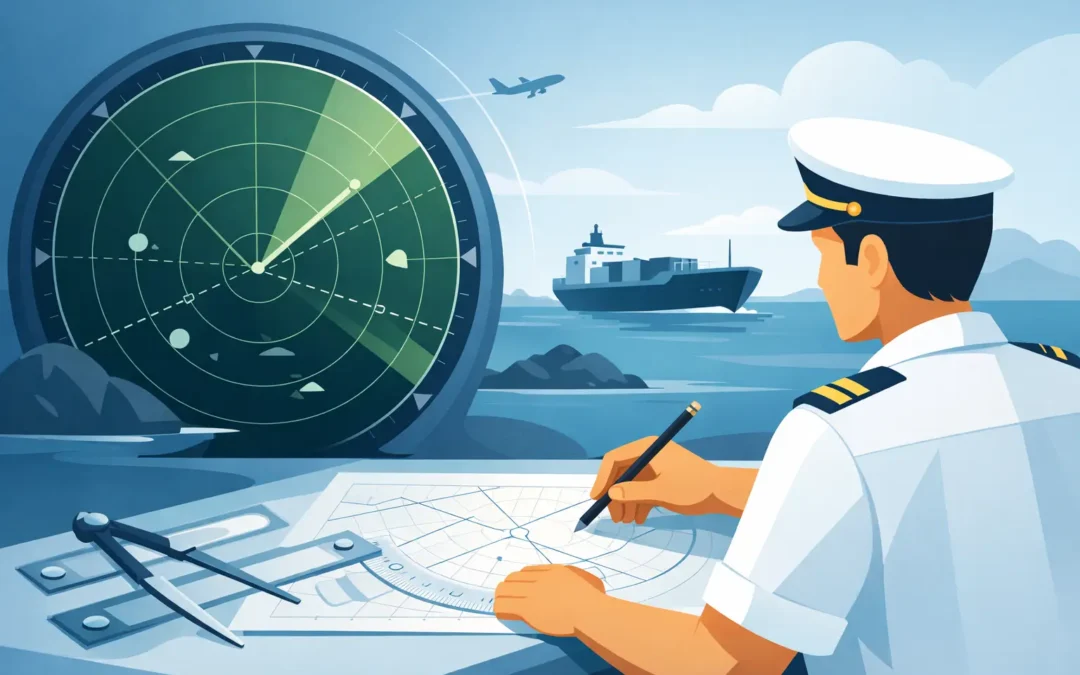
A radar plotting course question can feel straightforward until you are sitting with a plotting sheet, a set of bearings and ranges, and an assessor waiting for your decision. The pressure is rarely about drawing lines. It is about showing that you can turn radar information into a safe, timely action when another vessel is closing.
For Coxswain and Master candidates, radar plotting is not just a calculation to memorise before an AMSA assessment. It is evidence that you understand collision risk, can interpret relative motion and can make a practical navigational decision. That is exactly why the assessor may keep asking, “What would you do now?” after you have found the CPA.
What an assessor wants from radar plotting course work
An assessor is looking for more than a neat plot. You need to demonstrate a logical method, accurate calculations and sound judgement under the Collision Regulations. The individual question may ask you to find a target vessel’s course and speed, closest point of approach (CPA), time to CPA (TCPA), or the alteration required to create a safe passing distance.
Just as importantly, you may be asked to explain what the plot means. A CPA of 0.3 nautical miles might be acceptable in one situation and completely unsuitable in another. Vessel size, speed, sea room, visibility, traffic density, manoeuvrability and local operating requirements all matter. An answer that simply says, “I would alter course”, without explaining the direction, timing and expected result, is unlikely to show enough operational understanding.
Radar plotting questions can also expose gaps that have developed after time away from formal study. Many candidates have solid sea time and make safe decisions on the water, but have not drawn a relative-motion plot for several years. With structured practice, that skill comes back quickly.
Start with the foundations before plotting
A reliable plot begins before the pencil touches the paper. Check the radar information you have been given, including your own vessel’s course and speed, the target bearings and ranges, and the time interval between observations. Confirm whether bearings are true or relative. Mixing them up can produce a technically tidy but completely wrong answer.
You also need to be clear about the plot scale. If one centimetre represents one nautical mile, measure every vector and distance using that scale. Record times carefully and use the interval supplied. A small error in time conversion can significantly change a target’s calculated speed or TCPA.
Before calculating anything, ask yourself what the radar is showing operationally. Is the target maintaining a steady bearing while range decreases? Is it crossing from port to starboard? Is it overtaking? The plot should support your visual assessment, not replace it.
Relative motion and true motion
Most assessment plotting questions are built around relative motion. On a relative plot, your own vessel is treated as stationary at the plot origin, while the target’s movement shows its relative track. The line joining the plotted target positions is the relative-motion line.
If that line leads towards the origin, there is a risk of collision. The closest point on the relative-motion line to the origin gives the CPA. The distance along the line to that point, combined with the plotting interval and scale, gives the TCPA.
To find the other vessel’s true course and speed, you then use the vector triangle. Apply your own vessel’s course and speed vector in the correct direction and combine it with the relative vector according to the plotting method being used. The result is the target’s true vector. This is where candidates can lose marks by reversing a vector or measuring the reciprocal course.
Use a consistent method every time. Label the plot origin, observation times, target positions, relative track, CPA and vectors clearly. If you are talking through a plot in an oral assessment, those labels help you explain your reasoning without losing your place.
A practical radar plotting course method
The exact layout can vary between training materials, but the working sequence should remain disciplined:
- Plot each target observation from the origin using the correct bearing and range scale.
- Join the target positions in time order and extend the relative-motion line as needed.
- Measure the nearest distance from that line to the origin for CPA.
- Calculate the time to the nearest point by using the relative speed and the applicable time scale.
- Construct the vector triangle carefully if the question requires the target’s true course and speed.
- Decide whether the situation requires action and state the safest action in plain operational terms.
Do not rush from the plotted answer to a manoeuvre. First check that the result makes sense. If the target appears to be passing well clear visually but your plot indicates a very small CPA, revisit your bearings, ranges, time interval and vector direction. In a real wheelhouse, a result that does not fit the developing situation deserves investigation rather than blind acceptance.
Turning the plot into a safe action
This is the part that separates a calculation from competent watchkeeping. If the plot shows a collision risk, your action should be positive, early and readily apparent to the other vessel. Under the Collision Regulations, a small alteration that is difficult to detect may create uncertainty rather than safety.
An assessor may ask whether you would alter course, reduce speed, stop, or take a combination of actions. There is no universal answer. In open water, an early substantial alteration of course may be the clearest option. In confined waters, near a channel edge, among fishing vessels, or when operating a vessel with limited manoeuvrability, speed reduction may be necessary. Your response needs to recognise the limitations of the vessel and the water around it.
Say what you would monitor after taking action. A good answer might include checking the new relative-motion line, confirming that CPA is opening to an acceptable distance, maintaining a proper lookout and considering radio communication only where it genuinely assists. VHF should never be relied on instead of taking required collision-avoidance action.
Common errors that cost candidates marks
The most frequent mistakes are avoidable. Candidates sometimes use an incorrect time interval, confuse relative and true bearings, or measure a vector from the wrong end. Others find a CPA correctly but give no meaningful judgement about whether it is safe.
Another common issue is treating radar as perfect. Radar can be affected by clutter, sea state, rain, target size, shadow sectors, tuning, range scale and the quality of the target echo. A vessel may be difficult to acquire or track, particularly in poor conditions. In an assessment, acknowledging these limitations demonstrates practical awareness, provided you still explain how you would maintain a safe lookout and verify the situation.
Avoid vague language such as “keep an eye on it”. Be specific. State when you would reassess the target, what change you expect to see, and what you would do if the CPA continued to reduce.
Practise for the oral assessment, not just the worksheet
A worksheet lets you correct mistakes quietly. An oral assessment requires you to calculate, explain and make decisions while someone asks follow-up questions. That is why timed practice with spoken explanations is valuable.
Work through different scenarios: crossing situations, head-on risk, overtaking, multiple targets and situations where an alteration by your own vessel changes the relative plot. Practise explaining your work in order: identify the information, plot it, calculate CPA and TCPA, assess the risk, then state and monitor your action.
If you have a gap in your study or are unsure which plotting convention your assessor expects, individual revision can save a great deal of frustration. At True North Marine Training, radar plotting practice is focused on the calculations and decision-making questions candidates are likely to face, not just theory from a textbook.
The aim is not to produce a perfect-looking sheet. It is to become the person who can look at developing radar information, recognise the risk early and make a calm, defensible decision. Give yourself enough practice that, when the assessor asks what your plot means, you can answer with confidence.
Finally, remember that if you need assistance in preparing for an assessment True North Marine Training are available for one-on-one tutoring sessions at this link: https://www.truenorthmarine.com.au