
A fire spreading through an engine space, a crew member badly injured, or a vessel taking water can turn an ordinary watch into a distress situation very quickly. In that moment, emergency distress signal procedures are not a theory question. They are the actions that help rescuers find you, understand the problem and send the right assistance.
For Coxswain and Master candidates, this subject is regularly examined because it goes directly to command responsibility. An AMSA assessor is not simply looking for you to name a flare or say “make a MAYDAY”. They want confidence that you can assess the seriousness of an emergency, use the available equipment correctly, communicate clearly and continue managing the vessel and people aboard.
Start with the level of emergency
The first decision is whether the situation is distress, urgency or safety. Getting this right matters, but do not waste time debating terminology while the situation deteriorates. Deal with immediate threats to life and the vessel first.
A distress situation means there is grave and imminent danger and immediate assistance is required. Examples include abandoning ship, an uncontrolled fire, a serious collision, flooding that cannot be controlled, or a person needing urgent medical evacuation where delay may threaten life. The priority signal is MAYDAY.
An urgency situation concerns the safety of a vessel or person but does not yet require immediate assistance. A vessel disabled and drifting clear of hazards may send a PAN PAN. A medical situation may also warrant PAN PAN while advice or assistance is arranged. If the vessel is drifting towards rocks, a shipping lane or a bar entrance, the situation may quickly become distress.
A safety message is used for navigational or meteorological information, such as a dangerous floating object, an unlit mark or a serious local hazard. The correct proword is SÉCURITÉ.
In an assessment, explain your decision in operational terms. For example: “The engine failure is an urgency call while we have sea room and an anchor holding. If we begin dragging towards the reef and cannot regain control, I would escalate to a MAYDAY.” That demonstrates judgement, not rote learning.
Emergency distress signal procedures: secure, signal, communicate
Before making a call, take the quickest practical actions to protect people. Raise the alarm, put lifejackets on those who need them, account for everyone aboard and reduce the immediate danger. That could mean shutting down fuel, fighting a fire only if it is safe to do so, closing watertight openings, starting pumps, preparing survival craft or putting the vessel in the best position for weather and sea conditions.
At the same time, establish and record your position. Latitude and longitude from a GPS is ideal, but a good distress message can also use a bearing and distance from a clearly identified charted feature. A position from ten minutes ago may be poor information if you are drifting fast in strong wind or current. Keep updating it.
Where fitted and appropriate, activate a DSC distress alert. A properly connected VHF DSC set can transmit the vessel identity and position quickly, which is a major advantage when time is short. Select the nature of distress if you can do so without delay. If you cannot, send the alert first. The radio should then be used for the voice distress message on VHF Channel 16.
A clear MAYDAY message should include these details, in this order:
- MAYDAY spoken three times, followed by “THIS IS” and the vessel name spoken three times.
- Call sign and MMSI, if available.
- Position, including the time of the position if relevant.
- Nature of the distress and the assistance required.
- Number of people aboard and any other useful information, such as injuries, abandonment intentions or the vessel’s description.
A practical example is: “MAYDAY, MAYDAY, MAYDAY. THIS IS Southern Star, Southern Star, Southern Star, call sign ABCD. Position 20 nautical miles west of Rottnest Island, taking water rapidly after collision. Require immediate assistance. Four persons aboard, all wearing lifejackets. Preparing liferaft.”
Speak slowly and use plain language. A rushed, incomplete call creates confusion, particularly where vessel names, numbers and positions are hard to copy. Continue to listen and answer calls from a coast station, rescue authority or other vessel. Keep the radio watch going unless the emergency itself makes that impossible.
Use every suitable means of attracting attention
Radio is usually the fastest way to communicate the nature of the problem, but it should not be your only measure. Distress signalling works best in layers. A DSC alert, MAYDAY call, activated EPIRB, visual signal and lookout each improve the chance of being found.
An EPIRB should be activated when there is a real distress situation or a substantial risk that one is developing, particularly offshore or beyond reliable VHF coverage. Place it where it has the best possible view of the sky, keep it clear of obstructions and leave it operating. A 406 MHz EPIRB sends an alert through the satellite system, and registration information helps rescue authorities confirm vessel details and contact nominated people.
Do not activate an EPIRB as a casual precaution and then switch it off because another vessel appears nearby. False alerts pull rescue resources away from genuine emergencies. If the emergency has been resolved after activation, contact rescue authorities as soon as possible to cancel the alert through the proper channel.
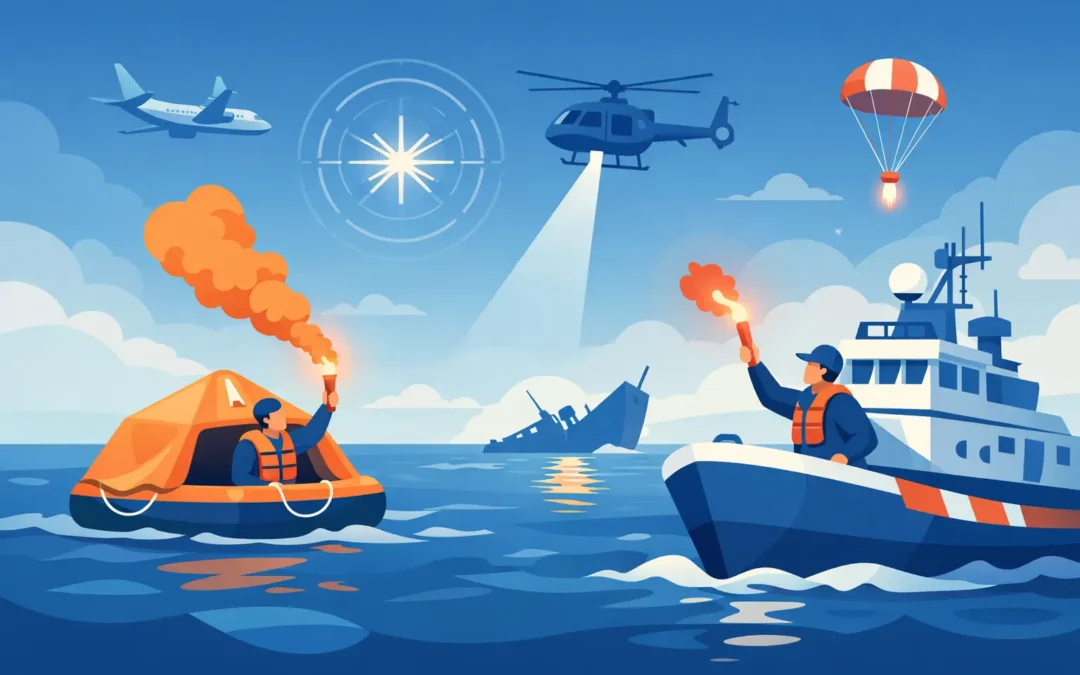
Visual distress signals remain highly relevant when aircraft or nearby vessels are within sight. The recognised signals include a red parachute flare, red hand flare, orange smoke signal, the SOS signal, and the N over C signal flags. At night, red hand flares and parachute flares may be effective, while orange smoke is generally a daylight signal.
Flares have obvious risks. Read the manufacturer’s instructions before departure, know where they are stowed, check expiry dates and protect them from water damage. When using one, keep it clear of people, fuel, liferafts, sails and the vessel’s canopy. A flare is most valuable when you can see, hear or reasonably expect a search vessel or aircraft to be close enough to detect it. Firing every flare early may leave you with nothing when rescuers are actually in the area.
What candidates often miss in oral assessments
Many candidates can recite the MAYDAY format but lose marks when asked what happens next. Emergency response is not a single radio transmission. It is a cycle of control, communication and reassessment.
An assessor may ask what you would do after sending a distress alert during a fire. A capable answer includes maintaining a radio watch, fighting the fire only within the crew’s capability, shutting fuel and ventilation where appropriate, preparing people for abandonment, monitoring the vessel’s position and updating rescuers when conditions change. If abandoning ship becomes necessary, take survival equipment, water, communications equipment where practical and the EPIRB if it is not already deployed.
Another common weak point is confusing a MAYDAY RELAY with a normal MAYDAY. A MAYDAY RELAY is used when you receive a distress message that has not been acknowledged, or when you know another vessel is in distress and cannot send its own call. You do not use MAYDAY RELAY for your own emergency.
Be ready to explain why an emergency signal is chosen, not just identify it. If you are operating a small commercial vessel close to shore, VHF may bring an immediate response. Far offshore, satellite distress equipment becomes more significant. On a busy harbour, visual signals may assist nearby traffic, but they do not replace a clear radio call. The equipment available, distance from assistance, weather, traffic density and nature of the casualty all influence your actions.
Practice the words before you need them
Under pressure, even experienced operators can forget a vessel position or jumble a radio message. The answer is simple practice. Sit at the radio, use a chart or GPS screen, and say a complete MAYDAY message aloud from several different scenarios. Practise a flooding situation, an onboard fire, a disabled vessel near danger and a medical emergency. Then explain whether each is MAYDAY or PAN PAN and what would cause you to escalate.
It is also worth checking the real equipment on the vessel you operate. Know how to select Channel 16, send a DSC distress alert, release and activate the EPIRB, locate flares and use the vessel’s emergency steering, pumps and firefighting equipment. A generic answer is rarely as convincing as one connected to the vessel and operation in front of you.
For candidates returning to study after time at sea, this is exactly the sort of subject where targeted oral practice pays off. True North Marine Training uses question-based revision to help candidates turn memorised procedures into calm, practical answers for their final assessment.
The aim is not to sound polished for an assessor. It is to be the person aboard who can take control, send the right signal and give everyone the best possible chance when the situation is at its worst.
To obtain more information on how we can assist you in preparing for a marine qualification assessment please email us at maritimetutor@yahoo.com or visit our website at https://www.truenorthmarine.com.au